7 Myths About Choosing an AI Image Generator
7 claims about AI image generators that don’t hold up
I’ve seen the same 7-ish claims slapped on AI image generator landing pages so many times that they’ve basically turned into wallpaper: studio quality in seconds, just type what you want, perfect for commercial use, no design skills needed, consistent characters every time, easy edits, cheap compared to hiring a designer. Sounds amazing. Also... a lot of it falls apart the second I actually test the thing.
I’m not doing a hype parade here. I’ve spent over $2,000 on AI subscriptions this year alone, and a dumb amount of that went into image tools, credits, and “pro” plans that promised way more than they delivered. (Why I Spend $1100/Month On AI | Ranking The Best AI Tools (2026)) So this section is my myth-by-myth review of the claims buyers hear most, then repeat, then regret after burning through 400 credits trying to fix one hand, one logo, or one weird plastic-looking face. (The classic Silicon Valley opening credits just got a ... - Instagram)
And yeah, the market is huge. The generative AI image space keeps ballooning because everyone wants fast visuals for ads, product mockups, thumbnails, social posts, and brand art. OpenAI said ChatGPT hit 100 million weekly active users in 2023, and image generation demand rode that same wave of mainstream adoption (OpenAI, 2023). (OpenAI's ChatGPT now has 100 million weekly active users) Adobe reported over 20 billion assets generated with Firefly by 2024, which tells me two things: people absolutely want this stuff, and volume doesn’t magically equal reliability (Adobe, 2024). (Adobe Firefly Statistics And User Trends 2026 - Companies History)
My testing lens is pretty blunt. I care about six things:
- Prompt accuracy — did the tool actually make what I asked for, or did it freestyle and hope I wouldn’t notice?
- Consistency — can it keep the same subject, style, lighting, or character across multiple generations?
- Editing control — can I change one part without the whole image melting into soup?
- Speed — not just raw render time, but how many attempts it takes before I get something usable
- Commercial readiness — does the output look polished enough to publish, and are the usage rights actually clear?
- Real cost — monthly plan, credit burn, upscales, retries, and the sneaky price of wasted time
That last one gets ignored constantly. A tool can look “cheap” at $10 to $20 per month, then quietly torch your budget if every decent result takes 15 prompts, 3 variations, 2 edits, and a separate upscaler. (Best cheap website builder options for every budget in 2026) I’ve had sessions where one usable image effectively cost me $4 to $12 once I counted credits and retries. That’s not catastrophic, but it’s nowhere near the breezy “unlimited creative output” pitch these companies love to mumble.
What surprised me most? Very few tools are broadly great. Some are freakishly good at prompt interpretation but bad at consistency. Some crank out gorgeous first drafts and then completely choke when I ask for a simple edit. Others are fast — like, 10 to 20 seconds fast — but the output has that glossy stock-sludge vibe I wouldn’t put near a paid campaign. Cute demo. Not enough.
So I’m going claim by claim. Not to be dramatic, but a lot of this category runs on selective screenshots and wishful thinking. Some AI image generators absolutely earn their keep. Some kind of suck. Most land in the messier middle, where one strength hides three annoying compromises. That’s the part I care about, because that’s the part buyers actually pay for.
Myth #1: The best AI image generator is always the most realistic
I keep seeing this one treated like obvious truth: if an AI image generator looks the most like a DSLR photo, it must be the best overall. I don't buy that. Not even close.
In my testing, photorealism is just one axis. A flashy one, sure. Easy to screenshot. Easy to sell on a landing page. But a tool can spit out a gorgeous fake portrait with pore-level detail and still completely ignore half the prompt, botch the layout, choke on text, and fall apart the second I ask for a revision. That's not "best." That's a very pretty miss.
What I care about is boring-sounding stuff that actually matters once I'm using the thing for real work: does it follow the prompt, can it handle more than one visual style, does the composition make sense, and can I edit the result without nuking the whole image? That's the difference between a demo toy and something I can actually use on Tuesday at 4:17 PM when a client wants three variations and the headline changed.
Prompt following is the first place the realism myth starts wobbling. I've tested image models that produce absurdly realistic lighting and skin texture, then casually skip details like "red jacket," "top-down view," or "holding a ceramic mug." Weirdly common. In one benchmark from Artificial Analysis, newer image models showed noticeable gaps between aesthetic quality and prompt adherence, meaning the prettiest model wasn't always the one that matched the request best (Artificial Analysis, 2025). And yeah, that tracks with what I found.
Style range matters too. A lot. If a model only shines when it's making glossy pseudo-photography, that's a narrow trick, not broad quality. I want to know if it can do flat vector art, editorial illustration, product mockups, children's-book softness, gritty poster energy, clean brand graphics — the whole messy buffet. Some of the most "realistic" tools I've used get strangely stiff outside that lane. Ask for a playful cut-paper illustration or a mid-century ad look and suddenly the magic evaporates.
Then there's composition. This gets overlooked because realism distracts people. Eyes go, "Whoa, that looks real," while the actual image has no visual hierarchy, awkward cropping, too much junk in the frame, or a subject placed where text overlays become a nightmare. Classic AI nonsense. A usable marketing image often needs space for copy, a clear focal point, and proportions that fit real channels like 1:1, 4:5, 9:16. If the model gives me a cinematic beauty shot that's impossible to adapt for Instagram Stories or a paid social ad, I don't care how realistic the reflections look.
And editability? Huge. Maybe the biggest sleeper issue.
I can forgive a slightly less realistic image if the tool lets me inpaint one area, preserve the character, swap the background, extend the canvas, and keep the composition intact. That's actual utility. Some hyper-real models are brittle as glass: touch one thing and the face changes, the product mutates, the logo melts, the mood swings from "premium skincare ad" to "uncanny airport billboard." Cool. Very helpful.
Realistic outputs still fail in the same old places, by the way. Hands are better than they were 2 years ago, but they're not solved. Text inside images is still a casino. Short labels sometimes work; anything longer and I start expecting alphabet soup. Consistency across multiple generations is another sore spot. Make one good image? Nice. Now make that same character in 6 poses, wearing the same outfit, with the same facial structure and brand colors. That's where a bunch of tools start sweating.
Brand-safe visuals are another headache nobody mentions in the hero section. Photorealism can actually make this worse. The more "real" the image looks, the more tiny errors stand out: extra fingers, warped packaging, ambiguous logos, jewelry merging into skin, facial expressions that feel off in a way I can only describe as haunted LinkedIn headshot. For marketers, that stuff isn't charming. It's unusable. One weird hand in an ad creative can tank trust instantly.
I've also found that illustrators, marketers, and social teams often care more about control than raw realism. Makes sense. An illustrator may want a model that respects line weight, shape language, and repeatable visual motifs, not one that keeps trying to turn everything into glossy stock-photo sludge. A marketer usually needs on-brand colors, clean negative space, product accuracy, and fast revisions. A social team wants volume, variety, and formats that fit actual posts without 20 minutes of cleanup per image. Different job. Different definition of "best."
Adobe's own survey data showed creators care heavily about speed and idea exploration, but commercial teams still put a premium on brand alignment and safe-for-work output rather than pure visual wow factor (Adobe, 2024). That doesn't surprise me at all. Nobody gets bonus points because the fake marble countertop looks insanely real if the packaging text is gibberish and the composition leaves nowhere to put the CTA.
So yeah, realism is nice. I like nice things. But if an AI image generator gives me 9/10 realism and 4/10 control, I'm probably not sticking with it. I'd rather use the one that gives me 7.5/10 realism, follows the prompt, survives edits, and doesn't melt when I ask for version three. That's the one I can actually ship with.
Myth #2: More features automatically mean better results
I see this myth all the time too: more buttons, more panels, more toggles, more magic. Supposedly that means better images. I don't buy that either.
In my testing, feature count is one of the sloppiest ways to judge an AI image generator. What matters is which features actually help me finish the job without wanting to throw my laptop across the room. A tool can brag about 40 controls and still be worse in real use than one with 8 that are placed well and behave predictably. Big difference.
The features I keep coming back to are pretty boring, honestly. Inpainting matters because I almost never get the whole image right on the first shot. I need to fix a hand, swap a product label, clean up a background, remove some mutant extra earring — normal stuff. Outpainting matters when I need to turn a square image into a banner, thumbnail, or ad creative without rebuilding the whole thing. Reference images matter when I need consistency instead of roulette. And style controls matter when “make it cinematic” is too mushy and I need a tighter visual lane.
Upscaling is useful too, but I think people overrate it. If the base composition is wrong, a 4x upscale just gives me a bigger wrong image. Congrats, now the mistakes are sharper.
That’s why I care less about raw feature volume and more about workflow. Can I generate, edit one region, expand the canvas, and export without bouncing between three menus and a settings graveyard? Or am I spelunking through tabs named things like advanced variance remix fidelity mode beta? Because yeah, that stuff adds up fast.
For beginners, clutter is a tax. I’ve watched people freeze when a tool throws 20 sliders at them before they’ve even typed a prompt. They start second-guessing everything: stylize at 100 or 250? weirdness on or off? image weight 1.2 or 1.8? And then they blame themselves when the output stinks. Sometimes the product is the problem. Not them.
Teams get hit differently, but it’s the same disease. If I’m working with a designer, marketer, or founder who just needs assets by 4 p.m., I don’t want a tool that requires a mini certification course. Every extra option creates one more place for inconsistency. Same prompt, different hidden settings, different seed behavior, different crop logic. Now the team is wasting 15 minutes just figuring out why version B looks nothing like version A. Annoying.
I’ve found the sweet spot is usually this: enough control to revise deliberately, not so much junk that basic tasks feel like cockpit management. Midjourney is a good example of a tool that got more useful as editing features improved, not just because it could make pretty images. Its web editor added inpainting and region edits that made iteration way less clumsy than the old “reroll and pray” routine (Midjourney, 2025). Adobe Firefly, meanwhile, isn’t the most exciting image model I’ve used, but Generative Fill and Expand are practical as hell when I’m already inside Adobe’s ecosystem (Adobe, 2025). Different vibe. Different job.
And then there’s the opposite case: feature-heavy tools that look incredible on paper and feel weirdly sluggish in real life. I’ve tested platforms where I had pose controls, structure guidance, ControlNet variants, style adapters, face swaps, LoRA support, negative prompt stacks, and six upscale modes. Sounds powerful. Sometimes is. But if I need three social images for a landing page hero, a blog thumbnail, and a rough ad concept in under 20 minutes, that setup can be slower than a simpler tool by a mile.
That’s the part people miss. Feature count is not workflow quality. I care about how many steps it takes me to go from idea to usable asset. If Tool A has 18 features and gets me a solid result in 4 minutes, while Tool B has 45 features and takes 14 minutes plus cleanup, Tool A wins. Easily. I don’t care who has the fancier settings accordion.
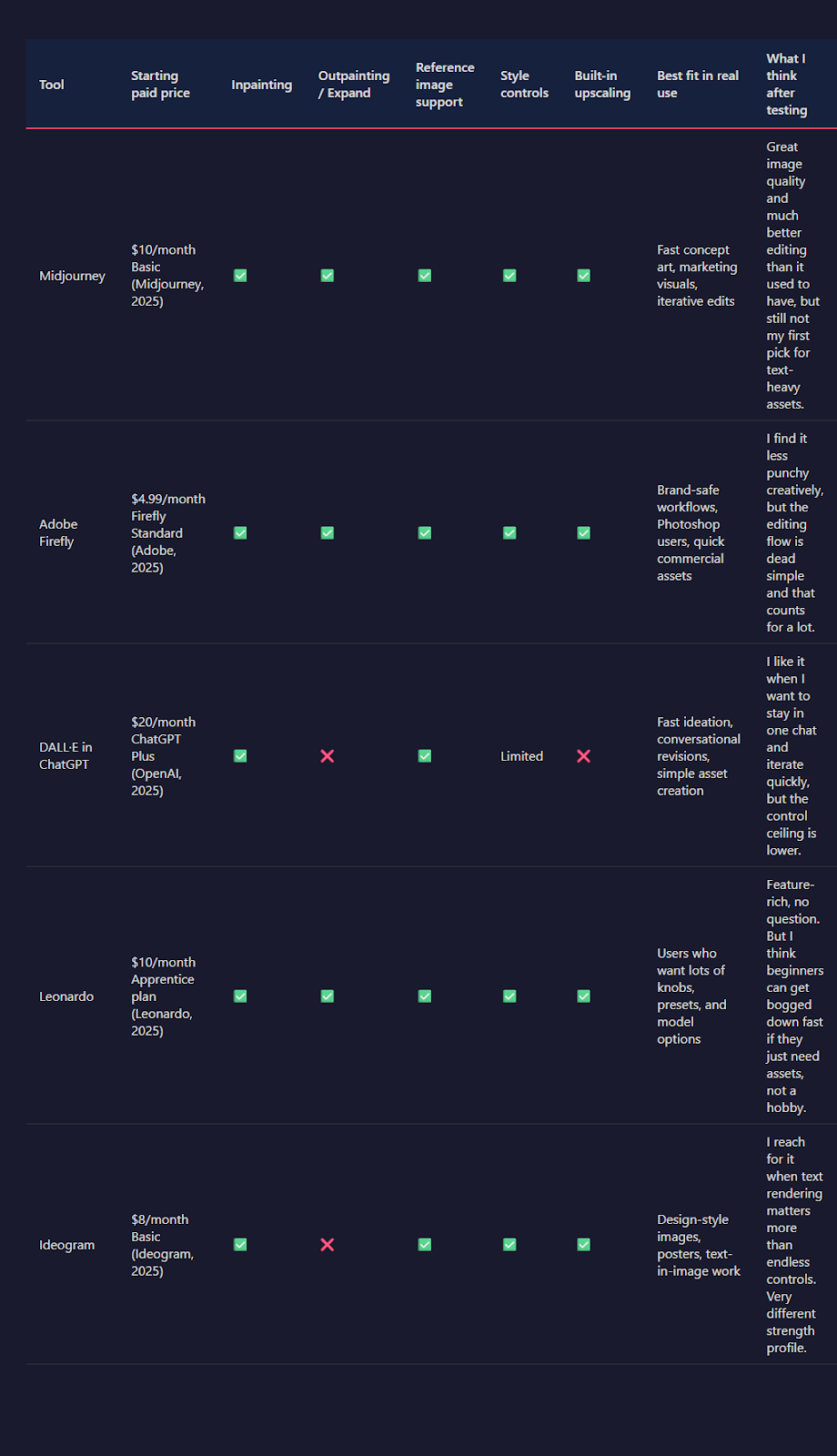
| Tool | Starting paid price | Inpainting | Outpainting / Expand | Reference image support | Style controls | Built-in upscaling | Best fit in real use | What I think after testing |
|---|---|---|---|---|---|---|---|---|
| Midjourney | $10/month Basic (Midjourney, 2025) | ✅ | ✅ | ✅ | ✅ | ✅ | Fast concept art, marketing visuals, iterative edits | Great image quality and much better editing than it used to have, but still not my first pick for text-heavy assets. |
| Adobe Firefly | $4.99/month Firefly Standard (Adobe, 2025) | ✅ | ✅ | ✅ | ✅ | ✅ | Brand-safe workflows, Photoshop users, quick commercial assets | I find it less punchy creatively, but the editing flow is dead simple and that counts for a lot. |
| DALL·E in ChatGPT | $20/month ChatGPT Plus (OpenAI, 2025) | ✅ | ❌ | ✅ | Limited | ❌ | Fast ideation, conversational revisions, simple asset creation | I like it when I want to stay in one chat and iterate quickly, but the control ceiling is lower. |
| Leonardo | $10/month Apprentice plan (Leonardo, 2025) | ✅ | ✅ | ✅ | ✅ | ✅ | Users who want lots of knobs, presets, and model options | Feature-rich, no question. But I think beginners can get bogged down fast if they just need assets, not a hobby. |
| Ideogram | $8/month Basic (Ideogram, 2025) | ✅ | ❌ | ✅ | ✅ | ✅ | Design-style images, posters, text-in-image work | I reach for it when text rendering matters more than endless controls. Very different strength profile. |
If I’m making fast assets — blog headers, rough ad creatives, YouTube thumbnails, placeholder product imagery — a simpler tool often wins. Not always. But often enough that I’d call it a pattern. I can get 80% of the way there in one clean pass, make one or two edits, export, done. That beats spending 25 minutes fiddling with settings to maybe squeeze out an extra 10% polish nobody will notice once the image is shrunk to 1200 pixels wide.
And yeah, there are times when the kitchen-sink tools earn their keep. If I need precise composition control, character consistency, or a weird art direction target with lots of revision rounds, extra controls can absolutely help. I’m not anti-feature. I’m anti-bloat.
So when I evaluate an AI image generator, I ask a much less glamorous question: does this feature help me finish work faster and with fewer rerolls? If the answer is no, it’s just decorative clutter wearing a product badge.
Myth #3: Cheap pricing means better value
Cheap plans fool people. Constantly.
I've tested enough image generators to know that the sticker price is usually the least interesting number on the page. A tool saying "$10/month" sounds cute until I hit the credit wall in 2 days, burn 30% of my generations on weird hands and melted text, then realize commercial use is gated behind a pricier tier. Suddenly that "budget" tool costs more than the one I almost skipped.
And this is where pricing pages get slippery. Some sell subscriptions with hard monthly image caps. Some use credits, where 1 prompt might cost 1 credit at low quality, 2 to 8 at higher settings, or more if I upscale, edit, or use faster generation. Some toss in watermark restrictions on free plans. Some technically allow commercial use, but only under terms that get fuzzy fast once client work enters the picture. Annoying? Very.
Low price, expensive outcome
In my testing, the real cost isn't price per month. It's price per usable image.
If I pay $10 and get 200 generations, that looks cheap at $0.05 each. Nice. But if only 20% are actually usable for my project, my real cost is $0.25 per usable image. If another tool costs $20, gives me 400 generations, and 35% are usable, that lands at about $0.14 per usable image. The "expensive" tool is suddenly the bargain. Weird little plot twist.
Failures matter more than people admit. If a model misses prompts, mangles composition, or needs 4 retries to get one decent output, the credit system turns into a paper shredder for money. I've seen cheap plans vanish ridiculously fast when I was testing product mockups, ad creatives, or scenes with text overlays. One bad model can eat 50 to 100 credits in a single afternoon without producing anything I'd publish.
What I actually compare
I don't just look at the monthly number. I look at the whole trapdoor underneath it:
- Subscription tier: What do I get at the entry plan versus the plan I actually need?
- Credit burn rate: How many images do those credits really buy at normal settings, not the marketing fantasy version?
- Hidden limits: Queue caps, slower generations, lower resolution, no editing tools, no private mode, or throttling during busy hours.
- Watermark rules: Free plans love slapping a badge on outputs. Fine for messing around, useless for client work.
- Commercial licensing: Can I use the image in ads, product pages, social posts, and paid client work without squinting at legal text for 20 minutes?
Here’s a practical comparison using widely used tools and publicly listed plan details. Pricing changes all the time, so I always re-check before subscribing, but these numbers are a solid reality check.
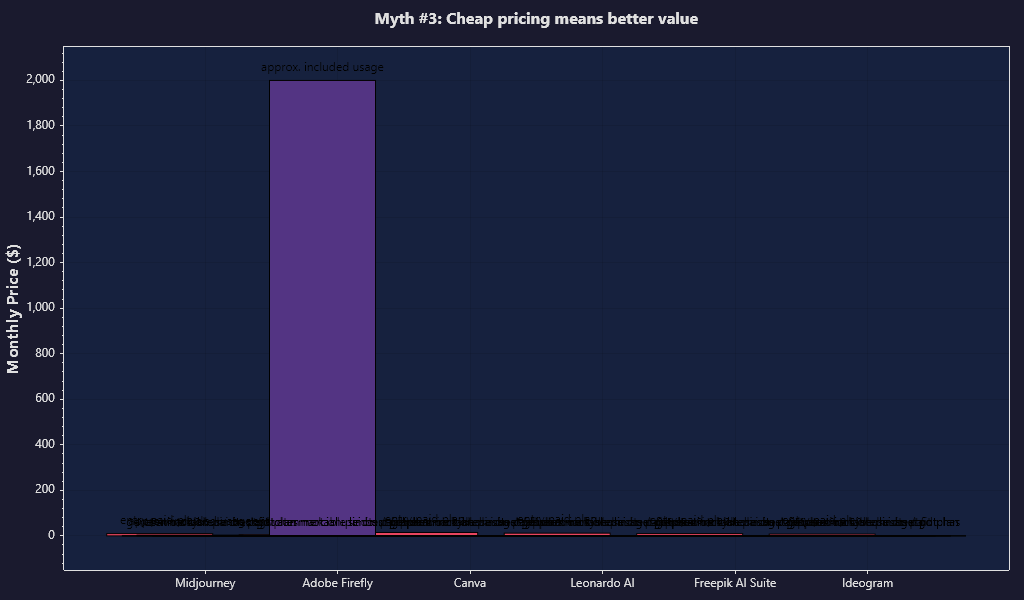
| Tool | Entry Paid Plan | Generation System | Approx. Included Usage | Watermark on Paid Output | Commercial Use on Paid Plan | Notable Limits / Gotchas | Best Fit |
|---|---|---|---|---|---|---|---|
| Midjourney | $10/month Basic (Midjourney, 2026) | Fast GPU hours | ~3.3 fast hours/month; image count varies by job type | ❌ | ✅ | Usage tied to GPU time, not simple image count; heavy iteration can chew through time quickly | Designers, power users |
| Adobe Firefly | $4.99/month Firefly Standard (Adobe, 2026) | Monthly generative credits | 2,000 monthly credits | ❌ | ✅ | Credit costs vary by feature; stronger value if I also use Photoshop or Express | Marketers, Adobe users |
| Canva | $14.99/month Canva Pro, 1 user (Canva, 2026) | App + plan-based usage | Magic Media usage included, but limits depend on feature and policy updates | ❌ | ✅ | Best when I need design layout plus image generation; weaker if I only want raw image output | Content marketers, small teams |
| Leonardo AI | $12/month Apprentice, billed monthly (Leonardo, 2026) | Daily/monthly tokens | Token-based; actual image count depends on model and settings | ❌ | ✅ | Cheap upfront, but token consumption jumps when I use premium models or extra controls | Hobbyists, prompt tinkerers |
| Freepik AI Suite | ~$10 to $16/month depending on billing cycle (Freepik, 2026) | Credits | Credit-based; varies by model and tool | ❌ | ✅ | Looks inexpensive, but mixed tools inside the suite can drain credits faster than expected | General creators, social content |
| Ideogram | ~$8/month Basic, annual billing (Ideogram, 2026) | Priority credits / generations | Plan-based generation allowance | ❌ | ✅ | Great for text-in-image work, but real value depends on how often I need retries for exact layouts | Ad creatives, posters, social graphics |
A few things jump out from that table. Midjourney doesn't charge in the neat little "100 images included" way people expect, which makes it harder for beginners to estimate spend. Adobe Firefly looks almost suspiciously cheap at $4.99, but if I'm already inside the Adobe ecosystem, it's actually one of the better deals because the commercial terms are clearer and the editing workflow saves me time after generation. Canva is sneaky: not bad, not amazing, but the value shoots up if I need to turn the image into a finished post five minutes later.
Credit systems are where cheap tools get weird
I don't hate credits automatically. I hate vague credits.
If a platform says "1,000 credits" but doesn't make it dead obvious whether a normal image costs 1, 4, or 12 credits depending on model, size, speed, and upscale settings, that price is basically fog. And fog is where bad deals hide. I've used tools where a supposedly generous monthly allowance evaporated after 150 to 250 serious generations because every upscale, variation, and edit counted as another charge. That's not evil exactly. It's just... not the bargain people think they're buying.
Free plans are even messier. A bunch of them slap on watermarks, restrict resolution, or block commercial use entirely. Fine if I'm making a cursed wizard frog for fun. Not fine if I'm building ad assets or client thumbnails on a deadline.
Value depends on who I am
For hobbyists: I usually care about low cost, room to experiment, and not getting punished for playing around. A cheaper token-based tool can be good here if the outputs are decent without tons of retries. If I’m generating 20 to 50 images a week for fun, I’d rather pay $10 to $15 for flexibility than $5 for frustration.
For content marketers: I care less about raw image count and more about speed to finished asset. Canva and Firefly often punch above their price because they cut post-processing time. If a tool saves me even 10 minutes per social graphic and I make 30 assets a month, that's 300 minutes back. Five hours. That matters more than saving $4 on the subscription.
For designers: Control and consistency matter more than bargain-bin pricing. I can burn through cheap credits fast when I'm chasing a very specific composition, lighting setup, or typography treatment. I'd rather pay for a model that gets me closer in 2 rounds instead of 7. My blood pressure agrees.
For agencies: Licensing and predictability become the whole story. If I'm producing client work at scale, I don't want murky commercial rights, random queue delays, or a plan that quietly throttles after heavy use. The lowest monthly price is almost irrelevant once team time and revision loops enter the picture.
A dead-simple cost per usable image formula
This is the framework I use:
- Step 1: Take the monthly plan cost.
- Step 2: Estimate how many total generations I can actually make at the settings I use most.
- Step 3: Track my usable hit rate. Not "kind of okay." Actually usable.
- Step 4: Use this formula:
Cost per usable image = Monthly cost ÷ (Total generations × Usable rate)
Example:
- Plan cost: $12/month
- Total generations: 300
- Usable rate: 25%
- Usable images: 75
- Cost per usable image: $0.16
Now compare that with a $24 plan:
- Total generations: 500
- Usable rate: 40%
- Usable images: 200
- Cost per usable image: $0.12
More expensive plan. Better value. That's the part people miss.
So yeah, I don't equate "cheap" with "smart buy" anymore. I want clear commercial rights, no watermark nonsense, predictable usage, and a model that doesn't waste my credits generating six haunted-looking near-misses before one decent result shows up. That's value. The price tag alone? That's just bait.
Myth #4: One AI image generator is best for everyone
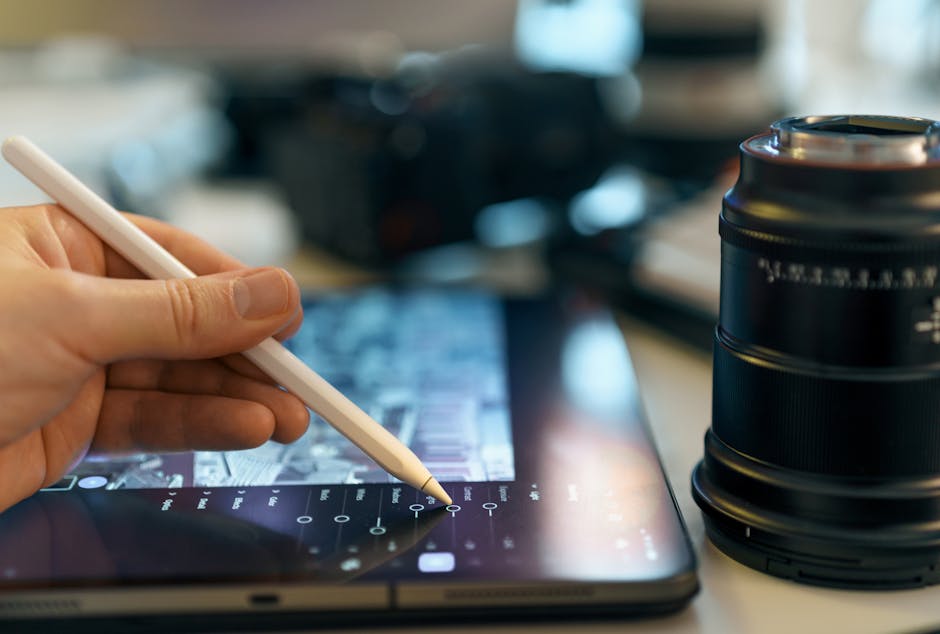
Nope. There isn't one AI image generator that's "best" for everyone. I've tested enough of these things to watch the same mistake play out over and over: someone buys the tool that wins on YouTube thumbnails or Reddit hype, then gets annoyed when it flops for their actual job.
That's not the tool being bad, exactly. It's the mismatch. And yeah, sometimes the marketing is absolutely guilty too.
If I'm making photoreal ad creative, I care about believable skin, product lighting, fabric texture, and whether I can get 20 usable variations that still feel like the same campaign. That's a very different ask from concept art, where I usually want mood, weirdness, strong composition, and a model that doesn't sand off every interesting edge trying to look "safe."
Same story with blog visuals. For blog headers and supporting images, I usually don't need gallery-level art. I need speed. I need decent consistency. I need something that won't make a business article look like a fever dream. Product mockups? Different beast again. There I care way more about object fidelity, angle control, clean backgrounds, and whether the tool turns a coffee mug into an archaeological artifact for no reason.
And social content is its own chaotic little circus. Fast iteration matters more there than perfection. If I'm making Instagram or LinkedIn visuals, I want a tool that can spit out 10 decent directions in a few minutes, not one gorgeous image after 14 prompt rewrites and a small emotional collapse.
What actually changes from tool to tool
In my testing, the big differences usually land in 4 buckets: speed, consistency, style range, and workflow fit.
- Speed: Some tools give me 4 usable options in 20 to 40 seconds. Others take 90 seconds or more per batch once servers are busy. That sounds minor until I'm 35 prompts deep and suddenly I've lost an hour to waiting.
- Consistency: This is where a lot of flashy demos fall apart. A model might make 1 amazing image, then completely lose the character, lighting setup, or product shape on the next 3 generations.
- Style: Some models are absurdly good at glossy realism. Others are better at painterly scenes, stylized frames, or cinematic concept work. Asking one tool to dominate every style is like asking one lens to shoot weddings, wildlife, and macro product photos equally well. Cute fantasy. Not real.
- Team workflow: This one gets ignored way too much. If I need shared folders, brand references, edit history, API access, or predictable licensing for client work, the "best image quality" tool can still be the wrong pick.
I've seen this mismatch constantly. A founder wants clean product ads, buys the artsiest generator on the market because the sample gallery looks sick, then wonders why every render feels like an A24 poster instead of ecommerce creative. Or a designer wants loose ideation for environments and creatures, picks the most literal commercial-image model, and gets stuff that looks polished but spiritually dead. Brutal.
The buyer expectation is usually weirdly simple: "I want amazing images." Sure. But amazing for what?
My shortlist by goal, not hype
If I want photoreal ads, I lean toward tools with stronger prompt adherence, better lighting realism, and more predictable outputs across batches. Midjourney still has a strong aesthetic punch, but for strict commercial control I often find it a little too eager to improvise. Useful for exploration. Less fun when a client needs the bottle label, hand pose, and scene composition to stay put.
If I want concept art, Midjourney is still one of the first places I look because it produces striking compositions fast and doesn't need as much hand-holding to create atmosphere. That's why it keeps showing up in creative workflows, and why its image quality reputation has held up in a bunch of industry roundups (TechRadar, 2026). But if I need tighter control over anatomy, poses, or iterative edits, I usually pair that kind of tool with something more steerable. Raw beauty isn't the whole job.
For blog visuals, I usually favor whatever gets me decent images quickly, with low prompt fuss and predictable commercial usage terms. This is where I think a lot of people overspend. If the image is going to sit at 1200 pixels wide above a SaaS article about CRM migration, I don't need museum-grade image synthesis. I need clean, relevant, and done before I get distracted by 6 other tabs.
For product mockups, I get picky. The tool has to respect object shape. It has to stop inventing extra buttons, phantom seams, or impossible reflections. Adobe Firefly tends to make more sense here for people already living in Photoshop because the editing loop is shorter and less annoying, especially when I need to composite, inpaint, and hand-fix details instead of praying the next prompt magically solves everything. Adobe has also pushed Firefly hard into commercial design workflows, which matters if I'm doing client work and don't want licensing ambiguity hanging over the project (Adobe, 2026).
For social content, I care about throughput. I want volume, variation, and enough consistency that a week's worth of posts doesn't look like 7 different brands had a custody battle over the account. Canva's AI image features and integrated design workflow are handy here, not because the outputs are always the best in a vacuum, but because getting from idea to finished post is faster for non-specialists. And speed wins a lot of ugly little real-world battles.
If I'm working with a team, I stop obsessing over single-image beauty and start caring about approvals, brand assets, templates, editability, and who can actually use the thing without needing a 45-minute prompt sermon. A tool that's 8% better visually but 3 times more annoying in a shared workflow? I probably won't stick with it. Life's too short.
One thing that surprised me: people often shop as if image generators are permanent identity decisions. They're not. I switch based on the job. Sometimes even within the same afternoon. One tool for ideation, another for cleanup, another for layout. That's normal now.
So my practical shortlist looks more like this: use a visually bold generator for concept exploration, a control-friendly one for ads and product work, a fast low-friction one for blog and social production, and a workflow-heavy option if multiple people need to touch the assets. That's messier than the hype version. It's also how this stuff actually works.
Anyone telling me one tool wins every category is either selling something or hasn't tested enough of them. Probably both.
What actually matters before you pick a tool
If I'm picking a tool now, I don't start with the prettiest gallery page. I start with a brutally boring checklist. Because the stuff that actually wrecks a purchase usually isn't "image quality" in the abstract — it's whether the model gives me the same level of quality on prompt 1, prompt 17, and prompt 43 when I'm tired, rushing, and trying to ship.
First: output consistency. One amazing image means almost nothing. I want to know how often a tool can produce 4 usable images out of 10 prompts, not 1 hero shot out of 50 generations. In my testing, that's the split that matters. Some tools are flashy slot machines: incredible once, mush the next eight times. Fun? Sure. Useful for client work? Nope.
I check consistency with the same prompt set every time — usually 20 prompts across product shots, portraits, text-heavy scenes, hands, interiors, and weird edge cases. If a tool only looks good when I baby the wording for 15 minutes, I count that against it. Hard.
Second: prompt reliability. This one gets weirdly underplayed. I care less about whether a model can make a masterpiece after six rewrites and more about whether it obeys plain-English instructions on the first or second try. If I ask for "a matte black coffee bag on a wooden counter, morning light, no extra objects," and it keeps sneaking in spoons, plants, and random ceramic nonsense, that's not creativity. That's disobedience dressed up as charm.
And yeah, some models are still bad at this. Especially once prompts get layered: camera angle, brand-safe styling, multiple subjects, exact composition, readable text. The more constraints I add, the more I see the cracks.
Third: editing workflow. This is where a lot of buying decisions should actually happen. Can I fix a nearly-good image, or do I have to regenerate from scratch like a maniac? Inpainting, outpainting, background replacement, layer control, reference image support, character consistency — that stuff saves absurd amounts of time. I can forgive a model that's 10% less impressive if it lets me repair the image in 90 seconds instead of rerolling 25 times.
That's why I don't just judge "generation." I judge iteration speed. If the workflow fights me, I'm out.
- Check how many edits it takes to get from first draft to usable image.
- Check whether the tool remembers style or characters across multiple images.
- Check if masking tools are precise or if they feel like finger painting with oven mitts.
- Check export options for aspect ratios, resolution, and commercial-ready files.
Fourth: pricing transparency. I get grumpy here because a lot of AI image pricing is still a little casino-coded. Credits, "fast hours," hidden upcharges for higher resolution, extra fees for editing features, plan limits that only show up after checkout... come on. If I can't estimate my monthly cost in under 5 minutes, I assume the pricing is designed to be slippery.
I prefer tools that make the math obvious: X images, Y edits, Z commercial rights, clear overage rules. Adobe Firefly's paid plans are at least tied to a broader Creative Cloud structure, which makes budgeting less annoying (Adobe, 2026). Midjourney's subscription model is simple to understand, even if usage limits can still pinch heavy users (Midjourney, 2026). A bunch of newer tools look cheap at $10 to $15 per month until I realize I'd burn through the included credits in two decent work sessions. That's not cheap. That's bait.
Fifth: licensing. This is the part people skip, right before using generated images in ads, client work, or product packaging. I always check commercial use terms, ownership language, training/data clauses, and whether the provider restricts trademarked or sensitive use cases. Adobe has leaned hard into commercially safer positioning with Firefly, including indemnity language for enterprise customers in some plans (Adobe, 2026). That's a real advantage if I'm working with brands that have lawyers and blood pressure.
For solo creators? The risk tolerance is different. But I still wouldn't shrug this off. "Probably fine" is not legal strategy. It's vibes.
So my buyer checklist is pretty simple:
- Can it produce consistent results across 20 to 30 real prompts?
- Does it follow instructions without constant prompt babysitting?
- Can I edit weak outputs instead of regenerating forever?
- Can I predict my monthly cost before I get ambushed by credits?
- Are the licensing terms clear enough for how I actually plan to use the images?
If I had to make the quick-pick call?
Beginners: I'd usually point them toward something with a friendly interface and low prompt fuss — often Adobe Firefly or Canva's AI image features, depending on whether they care more about brand-safe workflow or quick social graphics (Adobe, 2026; Canva, 2026). Less chaos. Fewer weird gotchas.
Power users: I still think Midjourney stays in the conversation because the ceiling is high and the aesthetic punch is real, especially if I'm willing to iterate aggressively. But if I need tighter editing control inside a production workflow, I lean toward tools that let me modify instead of rerolling endlessly. Pretty images alone don't pay my invoices.
Budget-conscious teams: I look for predictable seat costs, clear commercial rights, and enough included generations that the plan doesn't implode after week one. The cheapest sticker price almost never wins. I want the tool that costs $30 to $50 per user honestly, not the one that pretends to cost $12 and then nibbles me to death with credits.
My final verdict? Match the tool to the job, not the hype cycle. That's the whole thing. If a generator nails your exact prompt set, fits your editing rhythm, and doesn't play pricing hide-and-seek, that's your winner — even if Reddit is currently worshipping something else.
And before I commit to any paid plan, I run the same prompt set across every shortlist candidate. Same 10 to 20 prompts. Same categories. Same scoring. Do that once and the marketing fog clears fast. Weirdly fast, actually.
Frequently Asked Questions
What is the best AI image generator right now?
There is no single best option for everyone. The right choice depends on whether you care most about realism, prompt control, editing tools, speed, or budget.
Are free AI image generators good enough for professional use?
Sometimes for basic concepts or social graphics, but free tiers often limit resolution, credits, licensing, or consistency. Professional use usually needs stronger controls and clearer commercial rights.
Which AI image generator is best for beginners?
Beginners usually do better with tools that have simple prompting, clear presets, and predictable outputs rather than the most advanced interface.
How should I compare AI image generator pricing?
Look beyond monthly price. Compare credits, generation limits, editing features, commercial rights, and how many usable images you actually get per session.
Do AI image generators create copyright-safe images?
Not automatically. You should review each tool’s license terms, commercial usage policy, and any restrictions around training data or brand-sensitive content.
Sources & References
- Why I Spend $1100/Month On AI | Ranking The Best AI Tools (2026)
- The classic Silicon Valley opening credits just got a ... - Instagram
- OpenAI's ChatGPT now has 100 million weekly active users
- Adobe Firefly Statistics And User Trends 2026 - Companies History
- Best cheap website builder options for every budget in 2026
- Generative Upscale vs Normal (Real Results) - YouTube
- Release notes | GPT for Work Documentation
- 2026 Moving By Too Fast
- The gap between AI models is bigger than you think. Same prompt ...
- Social Media Image Sizes Guide 2026 | Ultimate Cheat Sheet
- AI Inpainting Explained: How to Edit Any Image Like a Pro (2026 Guide)
- In 2026, Kelly Osbourne's 2-Word Confession About Her Hands ...
- The world is a beautiful casino #betting #gambling #satire #politics ...
- Watch the official trailer for Alphabet Soup! A coming-of- ...
- Prompt to make exactly same image but different pose
댓글
댓글 쓰기