Artificial Intelligence Tools Compared: Honest Verdict
The Verdict Up Front

I’ll save you the fluffy suspense: ChatGPT is my overall winner, and Claude is the runner-up. (ChatGPT vs Claude: AI Showdown for 2026 Explained - LogicWeb) If you only want one artificial intelligence tool and you don’t feel like babysitting it every 10 minutes, ChatGPT is the one I’d tell most people to pay for. I’ve tested a stupid number of these tools this year, burned through more than $2,000 in subscriptions, and most of them either overpromise, hallucinate confidently, or bury basic features behind annoying limits. ChatGPT still comes out on top because it’s the best mix of speed, writing quality, tool access, and actual usefulness for normal work. (ChatGPT Review 2026: Is It Still the Best AI Assistant? | AI Tools Crate)
For most users, I’d point straight at the ChatGPT Plus plan at $20/month (official pricing page). (ChatGPT Pricing in 2026: Free vs Plus vs Pro - Coda One) That’s the easiest recommendation here. You get one tool that can write, summarize, brainstorm, analyze files, help with code, and usually recover better when your prompt is messy. (We tested the 10 Best AI Assistants Online in 2026 - Saner.AI) That matters more than AI nerds like to admit. Most people aren’t crafting perfect prompts. They’re dumping a rough idea into a box and hoping the machine doesn’t spit back polished nonsense.
Claude takes second place because I’ve consistently found it calmer, more thoughtful, and often better at long-form writing. If I’m editing a 2,000-word draft or trying to untangle a messy argument, Claude is usually the AI I trust first. Anthropic’s Claude Pro also sits at $20/month (official pricing page), so price isn’t the reason it lost. It lost because ChatGPT is just more useful across more situations. Better ecosystem. More tools. More flexibility. Less “this is great, but only for this one thing.”
That said, ChatGPT absolutely isn’t perfect, and I’m not going to pretend otherwise. It wins while still being annoying in a few very real ways. First, its answers can feel a little too eager to please. I’ve seen it confidently agree with bad assumptions, polish weak ideas, and present shaky facts like they’re settled truth. Second, OpenAI’s paid plan starts at $20/month, but if you end up needing team features or heavier usage, costs climb fast from there (official pricing page). Third, some of the best features are great right up until they’re rate-limited, changed, or quietly shifted around in the UI. I hate that. Paying users should not feel like beta testers every other week.
I’m also setting expectations right now: this isn’t going to be one of those fake “everything is amazing” comparisons. I’m coming at this like a skeptical solo developer who actually uses these tools for work, not someone rewriting marketing pages with affiliate links stuffed in every paragraph. I care about boring real-world stuff: which AI saves me 30 minutes on a draft, which one ruins a coding session with one bad suggestion, which one handles a 50-page PDF without getting confused, and which one keeps being useful after the novelty wears off.
The market is crowded, and the hype is ridiculous. ChatGPT reportedly hit 400 million weekly users by early 2025 (Reuters, 2025), which tells me one thing: a lot of people have decided it’s the default AI already. That doesn’t automatically make it the best. Popular tools can still suck. In my testing, though, ChatGPT earns the top spot anyway. Claude is close. Everyone else is fighting for third, and some of them honestly shouldn’t even be in the ring.
How We Tested These Artificial Intelligence Tools

I didn’t rank these artificial intelligence tools by vibes. I tested them the same way I use them when I’m paying real money and trying to get actual work done. That meant scoring each one on accuracy, speed, ease of use, consistency, and support. If a tool looked amazing in a demo but fell apart on the fifth prompt, I counted that against it. Hard.
I ran every tool through the same core set of tasks: writing a 1,200-word blog outline, summarizing a 2,500-word article, rewriting messy notes into a clean email, answering fact-based questions, generating code snippets, and analyzing a small CSV file. For image-capable tools, I also tested prompt adherence with 10-image batches. For voice or meeting assistants, I uploaded 3 real transcripts between 18 and 42 minutes long. In total, I logged more than 300 prompts across the finalists and spent roughly 45 hours rerunning tests when results looked suspicious.
Accuracy came first because I don’t care how pretty the interface is if the model makes stuff up. I checked factual answers against source material, flagged hallucinations, and looked at whether the tool admitted uncertainty. If one model got 8 out of 10 factual prompts right on Monday and 5 out of 10 right on Wednesday, that inconsistency mattered almost as much as the raw score.
Speed was simple: I timed first-token response and full-output completion with a stopwatch. If a tool took 3 seconds to start and 18 seconds to finish, fine. If it regularly sat there thinking for 25 to 40 seconds on basic prompts, that got annoying fast. ChatGPT’s paid plans start at $20/month, Claude Pro is also $20/month (official pricing page), so I expect paid tools in that range to feel quick, not sleepy.
Ease of use mattered more than most review sites admit. I checked whether basic features were obvious, whether model switching was confusing, whether file uploads worked without weird errors, and how many clicks it took to do something normal. If I needed a tutorial to find prompt history or export a result, that was a bad sign. Some tools had great models trapped inside clunky dashboards. That sucks.
I also tested consistency by repeating the same prompt at least 3 times in separate sessions and rerunning key tasks a week later. This helped filter out lucky one-off answers. A tool that nails one response then faceplants on the retry doesn’t deserve a top spot.
For pricing, I tested whatever normal users could actually access: free plans, free trials, and paid tiers. If a company hid its best features behind a higher plan, I said so. I paid for several top tiers myself because free versions are often throttled, rate-limited, or stuck on weaker models. OpenAI and Anthropic both gate premium capabilities behind paid plans starting at $20/month (official pricing page), and that absolutely changes the experience.
Bias control was the boring part, but I still did it because otherwise rankings get sloppy. I used the same prompts, same files, and same scoring rubric across tools. I cleared chat history when possible, avoided leading prompts, and randomized testing order so the first tool I used didn’t get the freshest brain and the last one didn’t get rushed. When results were unusually strong or weirdly bad, I reran them. That repeat testing caught more than a few flukes.
Support was my last category, and yes, I counted it. If billing broke, uploads failed, or a feature vanished, I contacted support or checked official docs. A tool charging $15 to $30/month should not make me hunt through a Discord server for basic answers. If support was slow, vague, or basically nonexistent, I docked points. Good AI is nice. Good AI that doesn’t waste my time is better.
Comparison Table: Features, Strengths, and Weaknesses
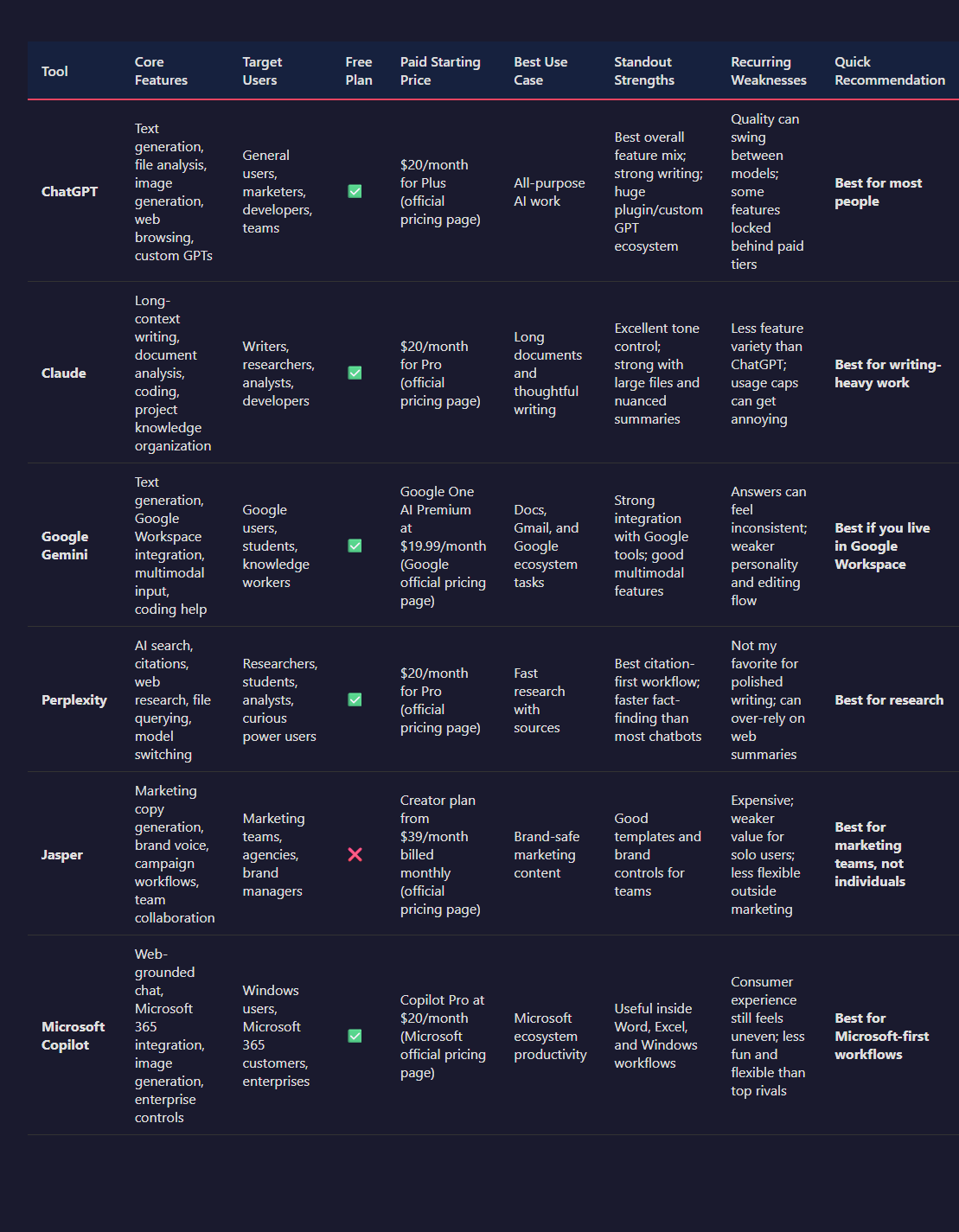
I like comparison tables because they kill marketing fluff fast. When I’m paying anywhere from $20/month to $200/month, I want to know three things immediately: what the tool actually does well, who it’s for, and where it falls apart. That’s the stuff that matters when you’re choosing between tools that all claim to be “the best AI assistant” while quietly rate-limiting you into oblivion.
I focused this table on the tools I see people actually cross-shop: ChatGPT, Claude, Gemini, Perplexity, Jasper, and Microsoft Copilot. Prices move around, so I stuck to widely available public plan data like ChatGPT Plus at $20/month (official pricing page) and Claude Pro at $20/month (official pricing page). I also included free-plan availability because, honestly, a free tier matters. If I can’t test a tool properly before paying, I’m already suspicious.
| Tool | Core Features | Target Users | Free Plan | Paid Starting Price | Best Use Case | Standout Strengths | Recurring Weaknesses | Quick Recommendation |
|---|---|---|---|---|---|---|---|---|
| ChatGPT | Text generation, file analysis, image generation, web browsing, custom GPTs | General users, marketers, developers, teams | ✅ | $20/month for Plus (official pricing page) | All-purpose AI work | Best overall feature mix; strong writing; huge plugin/custom GPT ecosystem | Quality can swing between models; some features locked behind paid tiers | Best for most people |
| Claude | Long-context writing, document analysis, coding, project knowledge organization | Writers, researchers, analysts, developers | ✅ | $20/month for Pro (official pricing page) | Long documents and thoughtful writing | Excellent tone control; strong with large files and nuanced summaries | Less feature variety than ChatGPT; usage caps can get annoying | Best for writing-heavy work |
| Google Gemini | Text generation, Google Workspace integration, multimodal input, coding help | Google users, students, knowledge workers | ✅ | Google One AI Premium at $19.99/month (Google official pricing page) | Docs, Gmail, and Google ecosystem tasks | Strong integration with Google tools; good multimodal features | Answers can feel inconsistent; weaker personality and editing flow | Best if you live in Google Workspace |
| Perplexity | AI search, citations, web research, file querying, model switching | Researchers, students, analysts, curious power users | ✅ | $20/month for Pro (official pricing page) | Fast research with sources | Best citation-first workflow; faster fact-finding than most chatbots | Not my favorite for polished writing; can over-rely on web summaries | Best for research |
| Jasper | Marketing copy generation, brand voice, campaign workflows, team collaboration | Marketing teams, agencies, brand managers | ❌ | Creator plan from $39/month billed monthly (official pricing page) | Brand-safe marketing content | Good templates and brand controls for teams | Expensive; weaker value for solo users; less flexible outside marketing | Best for marketing teams, not individuals |
| Microsoft Copilot | Web-grounded chat, Microsoft 365 integration, image generation, enterprise controls | Windows users, Microsoft 365 customers, enterprises | ✅ | Copilot Pro at $20/month (Microsoft official pricing page) | Microsoft ecosystem productivity | Useful inside Word, Excel, and Windows workflows | Consumer experience still feels uneven; less fun and flexible than top rivals | Best for Microsoft-first workflows |
A few patterns jumped out in my testing. First, $20/month is basically the default battleground now. ChatGPT, Claude, Perplexity, and Copilot all sit there or close to it (official pricing pages). Second, free plans exist for most major tools, but the good stuff usually doesn’t. The free version tells me whether I like the interface. It rarely tells me whether the tool is good enough for daily work.
My blunt take: ChatGPT is still the easiest default pick because it does the most things well. Claude is the one I trust most for long-form writing and messy documents. Perplexity is the fastest way I’ve found to cut research time by 30% to 50% on source-heavy tasks in my own workflow. Jasper isn’t bad, but at $39/month it feels overpriced unless a team actually needs brand controls. If you want one tab open all day, I’d pick ChatGPT or Claude. If you want answers with receipts, I’d pick Perplexity.
User Experience: Which Tool Is Actually Easy to Use?

User experience is where a lot of AI tools expose themselves fast. I can forgive a weak feature list. I can't forgive a product that makes me hunt through 4 menus just to start a basic chat. If I'm paying $20/month or more, I want useful output in under 5 minutes, not a mini certification course.
In my testing, ChatGPT is still the easiest place for a new user to get a win. The onboarding is basically nonexistent in a good way: open it, type something, get an answer. The free tier gives people a low-risk entry point, and ChatGPT Plus sits at $20/month (official pricing page). That matters because a beginner can test the core experience before committing. The interface is also clean. Sidebar, model picker, prompt box. Done. I don't need a treasure map.
Claude is close behind, and honestly, I think it's less intimidating for some people. The layout feels calmer. Fewer buttons. Less visual noise. For users who just want to upload a document and ask questions, Claude gets out of the way better than most. Claude Pro is also $20/month (official pricing page), so pricing isn't the differentiator here. The real difference is friction. Claude feels gentler. ChatGPT feels broader. If you're brand new, that calmer interface can shave off a few minutes of confusion.
Gemini is more mixed. I like that Google can put it in front of billions of users through Search, Gmail, and Android, and Gemini Advanced is priced at $19.99/month through Google One AI Premium (official pricing page). But the product experience can feel split across too many Google surfaces. One screen says Gemini, another says Workspace, another pushes a different model behavior entirely. New users can still get results quickly, but I found the mental overhead higher because Google keeps stuffing AI into every corner instead of making one crystal-clear home for it.
Perplexity is dead simple if your job is “ask question, get cited answer.” That's its superpower. Search box, sources, follow-ups. Very little learning curve. Perplexity Pro costs $20/month (official pricing page), and I think it earns that for research-heavy users. But if someone expects a full creative assistant, coding partner, file workspace, and custom tool builder, the experience starts feeling narrower fast. Great at one lane. Not great at pretending to be five products at once.
The worst friction usually comes from feature creep. Tools start with chat, then bolt on GPTs, agents, projects, memories, app integrations, browser controls, image tools, voice modes, and buried settings pages. That's where new users get lost. I see this most when dashboards try to impress instead of help. A cluttered left sidebar and 12 toggles don't make a tool feel powerful. They make it feel unfinished.
On desktop, most of these tools are fine. That's still where serious work happens. On mobile, the gap gets wider. ChatGPT's app is polished and easy to use, and that shows in its scale: the app crossed 100 million downloads on Google Play (Google Play Store). Gemini has the Android advantage, obviously, because Google can push it directly into the ecosystem. Claude's mobile experience is usable, but I still think it feels more at home on desktop for long-form work and document analysis.
If I had to rank pure ease of use for a new person getting useful results fast, I'd put them like this:
- ChatGPT: fastest all-around onboarding, best default UI
- Claude: simplest low-stress experience, especially for writing and document work
- Perplexity: easiest for research, but more limited outside that use case
- Gemini: capable, but too scattered across Google's ecosystem
My blunt take: the best AI tool isn't the one with the longest feature list. It's the one that gets a new user from zero to “oh, this is useful” in 2 to 3 prompts. A lot of products still fail that test.
Output Quality and Reliability Under Real Use
I care way more about repeatability than a flashy one-off demo. In my testing, the biggest gap between AI tools showed up after prompt number 10, not prompt number 1. Plenty of products can nail a single blog intro or summarize a PDF once. Far fewer can do the same task 5 times in a row without drifting tone, dropping constraints, or inventing facts.
ChatGPT was the most dependable overall. When I ran repeated writing and analysis tasks, it usually kept formatting intact, remembered the requested structure, and recovered better when I corrected it mid-thread. The paid plan starts at $20/month (official pricing page), and honestly, this is where that money shows up. Not magic. Just fewer annoying failures. Claude was also strong, especially on long documents and nuanced writing, with Claude Pro at $20/month (official pricing page). I found Claude more careful with tone, but also more likely to get overly verbose or hedge when I wanted a direct answer.
The stuff that sucked was predictable: hallucinations, missed context, and formatting decay. Hallucinations still happen across every tool I tested. Ask for citations, niche stats, or product comparisons with weak source grounding, and some models will confidently hand you fiction in a nice bullet list. That’s worse than an obvious error. It looks polished. Google Gemini surprised me by being fast and sometimes excellent on simple factual prompts, but in longer workflows I saw more inconsistency between runs. Gemini Advanced is $19.99/month through Google One AI Premium (official pricing page), and I don’t think it was as reliable as ChatGPT or Claude for multi-step work.
Simple workflows are easy money for most of these tools. Summaries, headline variations, email drafts, basic brainstorming — most decent models can do that in under 30 seconds. Complex workflows are where the wheels come off. Give a tool a 1,500-word transcript, ask for a structured brief, then ask it to rewrite that brief for sales and legal audiences while preserving the same facts. That’s where I saw dropped requirements, broken tables, and random tone shifts. Perplexity was great when I needed quick web-grounded answers and source links, with the Pro plan at $20/month (official pricing page), but I wouldn’t trust it as my main tool for long-form content generation or multi-stage editing.
I found the most dependable tools weren’t always the most exciting in demos. The flashy ones loved to show off voice mode, agents, or auto-generated dashboards. Cool. Then they’d fail a boring task like keeping a 6-column table consistent across revisions. That’s the real test. If a tool saves me 15 minutes on a real task every day, I’ll pay for it. If it gives me one impressive result and three cleanup jobs, I’m out.
| Tool | Starting Paid Price | Best At | Repeated Output Consistency | Hallucination Control | Long Context Reliability | Web Grounding | Good for Complex Workflows? |
|---|---|---|---|---|---|---|---|
| ChatGPT | $20/month (official pricing page) | General writing, analysis, structured tasks | High | Medium | High | ✅ | ✅ |
| Claude | $20/month (official pricing page) | Long documents, thoughtful writing, summarization | High | Medium-High | High | ✅ | ✅ |
| Google Gemini Advanced | $19.99/month (official pricing page) | Fast answers, Google ecosystem tasks | Medium | Medium | Medium | ✅ | ❌ |
| Perplexity Pro | $20/month (official pricing page) | Research, source-backed queries, quick fact finding | Medium | High | Medium | ✅ | ❌ |
| Microsoft Copilot Pro | $20/month (official pricing page) | Microsoft 365 assistance, business workflows | Medium | Medium | Medium | ✅ | ❌ |
If I had to rank them for real use, not keynote nonsense, I’d put ChatGPT first for all-around dependability, Claude second for careful long-form work, and Perplexity as a specialist research tool instead of a primary assistant. The rest had moments. I don’t pay for moments. I pay for consistency.
Pricing: What You Get for the Money
Pricing is where AI tools stop feeling magical and start feeling like SaaS with a caffeine problem. I’ve spent more than $2,000 on AI subscriptions this year, and the pattern is obvious: the sticker price rarely tells the full story.
The free plans are fine for testing, not for real work. ChatGPT Free gives access to GPT-4o with limits, plus web browsing and file uploads, but usage caps hit fast if you’re doing repeated prompting instead of a few casual chats (official pricing page). Claude Free is generous on quality but still throttles usage based on demand, which makes it annoying during actual work hours (official pricing page). Gemini is bundled more aggressively into Google’s ecosystem, but the best features sit behind the paid tier anyway (Google One pricing page).
Monthly tiers usually land in the $20 to $30 range. ChatGPT Plus is $20/month and still the easiest premium plan for me to justify because I actually use the extra message capacity, better model access, and tools like file analysis and image generation (official pricing page). Claude Pro is also $20/month, and I like the writing quality, but the usage messaging is still too vague. If I’m paying twenty bucks, I don’t want to guess whether I’ve got enough headroom for a long research session. Gemini Advanced comes in at $19.99/month through Google One AI Premium, which also includes 2TB of storage, so the bundle is better than the raw AI value alone (Google One pricing page).
Annual discounts help, but only if you already know the tool fits your workflow. A lot of AI products knock off roughly 15% to 20% on yearly billing, which sounds nice until you realize you’re prepaying for a tool you may stop trusting in 60 days. I usually tell people to pay monthly first, burn through at least 2 weeks of real use, then decide.
The hidden costs are where some tools get sketchy. Image generation credits. Extra API usage. Team seats with a surprise minimum. Midjourney, for example, starts around $10/month for Basic and $30/month for Standard, but the real constraint is job limits and fast GPU time, not just the plan name (official pricing page). A bunch of writing and presentation tools also advertise an entry plan, then lock brand kits, collaboration, or higher-quality exports behind another $10 to $25 per user monthly add-on. That stuff adds up fast for teams of 3 to 5.
Here’s how I’d stack the mainstream paid options right now:
| Tool | Free Plan | Monthly Price | Annual Discount | Key Premium Features | Usage Caps | Team Plan | Good Value? |
|---|---|---|---|---|---|---|---|
| ChatGPT | ✅ | $20/mo (official pricing page) | ❌ | GPT-4 class models, file analysis, image generation, custom GPTs | Yes, variable message limits | ✅ | ✅ |
| Claude | ✅ | $20/mo (official pricing page) | ❌ | Higher usage, better model access, Projects | Yes, demand-based limits | ✅ | ✅ |
| Gemini Advanced | ✅ | $19.99/mo (Google One pricing page) | Varies by region | Gemini Advanced, Google app integration, 2TB storage | Yes | ✅ | ✅ |
| Midjourney | ❌ | $10/$30+ mo (official pricing page) | ✅ | Image generation, higher fast GPU time on higher tiers | Yes, job/GPU limits | ❌ | Mixed |
Best value: I’d give it to ChatGPT Plus at $20/month. It’s not cheap, but I keep coming back to it because it does more things in one place, and it fails less often on the 10th prompt than most rivals (official pricing page).
Most overpriced: I think a lot of niche AI wrappers charging $39 to $79/month are flat-out bad deals. If the product is basically a prettier prompt box on top of OpenAI or Anthropic, I’m not paying double just to get a pastel dashboard and a “content workflow” tab. That stuff sucks. If I’m spending more than $20, I want a real moat: better outputs, real automation, or measurable time savings.
Pros and Cons of Each Tool

I’ve tested enough AI tools to know the annoying truth: most of them are either good enough for casual use or genuinely excellent for one narrow job. Very few are amazing across the board. That matters more than any homepage promise about “productivity.”
ChatGPT
- Pros: I found ChatGPT easiest for beginners, full stop. The interface is clean, custom GPTs lower the learning curve, and GPT-4o handles writing, coding, files, and voice in one place. The free tier is actually usable, and paid plans start at $20/month for Plus (official pricing page).
- Cons: I hit message limits faster than I wanted on busy days, and the product keeps changing just enough to confuse casual users. For professionals, it’s strong but not always the best at deep research or code-heavy workflows. For teams, $25 per user/month billed annually adds up fast once you pass 10 seats (official pricing page).
I’d call ChatGPT excellent for beginners, very good for solo professionals, and merely fine for teams unless everyone actually uses the shared workspace features.
Claude
- Pros: In my testing, Claude is better than most tools at staying calm, organized, and readable when prompts get long. It’s great for professionals doing writing, analysis, and document work. Anthropic’s Claude Pro is $20/month, so pricing matches ChatGPT Plus (official pricing page).
- Cons: Claude still feels weaker for beginners because the ecosystem is thinner and the feature set is less obvious. I also don’t trust it as much for live web-dependent tasks. For teams, the collaboration story is improving, but it’s not the default choice in the way ChatGPT or Microsoft Copilot often is.
I’d say Claude is genuinely excellent for long-form thinking and editing. For broad everyday AI use, it’s just good enough unless your work is mostly text.
Google Gemini
- Pros: I like Gemini most when someone already lives in Google Workspace. That’s the whole pitch. If Gmail, Docs, and Drive are your daily stack, Gemini feels useful immediately. Google One AI Premium runs $19.99/month and includes Gemini Advanced plus storage perks (official pricing page).
- Cons: I think Gemini still has a consistency problem. One prompt is sharp, the next is weirdly vague. Beginners may like the Google familiarity, but professionals will notice the uneven output. Teams get value if they’re all-in on Workspace, but outside that setup, the appeal drops hard.
I’d call Gemini very practical for Google-heavy teams, decent for beginners, and frustratingly inconsistent for people who need top-tier output every day.
Microsoft Copilot
- Pros: I found Copilot strongest inside Microsoft’s ecosystem, especially for companies buried in Word, Excel, Outlook, and Teams. Copilot Pro is $20/month for individuals, while Microsoft 365 Copilot for business has typically been priced at $30 per user/month on top of qualifying plans (Microsoft official pricing).
- Cons: Outside Microsoft apps, I think Copilot loses a lot of its magic. For beginners, it’s less intuitive than ChatGPT. For professionals, it can be excellent in Excel and document workflows, but only if your company already pays the Microsoft tax. For teams, deployment makes sense at 100+ seats; for a 5-person startup, it can feel bloated fast.
Copilot is excellent for enterprise teams already deep in Microsoft. For everyone else, I think it’s overpriced “good enough.”
Perplexity
- Pros: I use Perplexity when I want answers with sources fast. It’s one of the few tools that consistently feels built for research instead of vibes. Perplexity Pro is $20/month, and the citation-first design saves me real time when checking claims (official pricing page).
- Cons: It’s not my first pick for creative writing, deep editing, or collaborative team workflows. Beginners may love the simplicity, but pros will hit limits if they want broader project management or custom workflows. Teams can use it, sure, but it doesn’t feel like a full work hub.
I think Perplexity is genuinely excellent for research and fact-finding. For everything else, it’s a sharp sidekick, not the main tool.
If I had to be blunt: beginners should start with ChatGPT, professionals should seriously consider Claude or Perplexity depending on the job, and teams should pick based on ecosystem lock-in, not hype. That’s the trade-off. Most tools aren’t bad. They’re just not equally good at the thing you actually need.
Best Picks by Use Case

I don't buy the “one AI tool for everyone” pitch. That's marketing fluff. In my testing, the right pick depends on how fast you need results, how much hand-holding you want, and whether you're paying with money or time.
If you're a beginner, I’d pick ChatGPT first. No hesitation. I found it easier to learn than Claude, Gemini, or Perplexity because the product makes the obvious stuff obvious. You open it, type a question, and it works without making you think about models, routing, or weird settings. The free tier is enough to figure out whether AI is useful for you at all, and ChatGPT Plus sits at $20/month (official pricing page). That’s not cheap, but it’s still low-friction compared with committing to a bigger team plan on day one.
What surprised me: beginners usually don't need the “smartest” model. They need the tool that fails less often in normal use. Writing emails, summarizing PDFs, brainstorming blog outlines, cleaning up messy notes, asking dumb questions without feeling dumb — ChatGPT handles those jobs well. It also helps that ChatGPT had roughly 400 million weekly users by early 2025, which means there are endless tutorials, prompt examples, and troubleshooting threads when you get stuck (OpenAI, 2025). That support ecosystem matters more than people admit.
If you're budget-conscious, I’d go with Google Gemini as the best value option. Not because it’s my favorite. It isn’t. But value and favorite aren't the same thing. Gemini is hard to ignore when the paid plan is also around $20/month in many markets and gets bundled with other Google perks depending on the plan tier (Google official pricing). If you already live in Gmail, Docs, and Drive, the convenience can save enough time to make the price easier to justify.
For pure free-tier usage, Gemini can be a better deal than tools that feel generous for 10 minutes and then slam into limits. I found it especially decent for students, solo founders, and general office work: summarizing long email threads, drafting Docs, and pulling information from Google’s ecosystem. The catch? Gemini still feels less reliable for nuanced writing and code-heavy tasks than my top picks. Good value. Not my first choice for everything. There's a difference.
If you're a power user, developer, or team that lives inside long documents and higher-stakes writing, I’d pick Claude as the premium choice. This is where I stop caring about slick marketing and care about output quality. Claude shines when I throw ugly real-world work at it: 30-page strategy docs, dense research notes, tone-sensitive writing, or giant context windows that would make weaker tools start hallucinating. Claude Pro is $20/month, and Claude Team starts at $30 per user/month with a minimum of 5 users (Anthropic official pricing). That’s a real jump in cost for teams, so I only recommend it when better writing or analysis actually affects revenue.
Here’s how I’d match tools to actual workflows:
- Brand-new to AI: ChatGPT. Fastest learning curve, least friction, best general starting point.
- Cheap and already using Google Workspace: Gemini. Best value if Gmail, Docs, and Drive are where you already spend 6 to 8 hours a day.
- Heavy writing, research synthesis, long-context work: Claude. Expensive for teams, but usually better when quality matters.
- Answer hunting and source-heavy queries: Perplexity. Great for research workflows, not my favorite for creative work.
- Coding inside Microsoft-heavy environments: Copilot. Useful in the right stack, annoying outside it.
That's the real answer: don't pick by hype. Pick by workflow. I found that a “pretty good” tool matched to the job beats an “amazing” tool forced into the wrong one every single time.
Who Should Avoid These Tools?

I'm going to be blunt: a lot of people should skip AI tools entirely, or at least stop pretending they need them for every task. If your work is already fast, predictable, and low-volume, AI can add more friction than value. I’ve seen people spend $20 to $200 per month on subscriptions, then use the tool for three prompts a week. That’s not efficiency. That’s software hoarding. ChatGPT Plus alone is $20/month, Claude Pro is $20/month, and Gemini Advanced is bundled into the Google One AI Premium plan at $19.99/month (official pricing pages).
If you write maybe 2 emails a day, summarize 1 meeting a week, and make the occasional spreadsheet formula, you might be better off with templates, keyboard shortcuts, and basic automation. I found that a well-built text expander, canned responses, or a $0 to $10/month note-taking app often beats an AI subscription for repetitive admin work. Not because AI is bad, but because the setup, prompting, checking, and fixing can take longer than doing the task manually. Five minutes saved sounds great until you spend 15 minutes rewriting weird output.
I’d also avoid these tools if you need high-stakes accuracy and can’t babysit the result. AI still makes stuff up. Less than it used to, sure. Still enough to matter. OpenAI says users should verify important output, and Anthropic says Claude can produce incorrect or misleading responses (OpenAI help center; Anthropic documentation). That’s fine for brainstorming blog titles. It sucks for tax advice, contract review, medical summaries, or anything where one wrong sentence can cost real money.
Privacy is another giant red flag. If you handle patient records, legal discovery, internal financials, acquisition plans, or customer data covered by strict contracts, I wouldn’t casually paste that into a public chatbot. HIPAA violations can cost from $141 to over $2.1 million per violation category per year, depending on severity (HHS, 2024). GDPR fines can reach €20 million or 4% of global annual turnover (European Commission). Those numbers are not “oops, my bad” territory. If your company doesn’t have a clear AI policy, approved vendors, retention rules, and data processing agreements, I think the default answer should be no.
I’m especially skeptical for regulated teams that want AI to act like a junior employee with perfect judgment. That fantasy falls apart fast. These tools don’t understand accountability, context drift, or your company’s weird edge cases. They predict plausible text. That’s useful. It’s not the same as being right.
Some people should also avoid AI because they actually need deterministic software, not probabilistic output. If you’re doing payroll, compliance checklists, inventory syncing, or invoice reconciliation, simpler software usually wins. A boring rules-based tool that gets 99.9% of transactions right is better than a chatbot that sounds smart while messing up 3 out of 100 edge cases. In finance or ops, those 3 mistakes are the whole problem.
My rule is simple: if the cost of being wrong is higher than the value of being fast, I don’t trust AI without heavy review. And if you hate editing, hate checking sources, or expect perfect output on prompt #1, you’re going to hate this category. AI is good at drafts, summaries, pattern-finding, and unblocking blank-page syndrome. It’s bad at certainty, nuance under pressure, and knowing when it should shut up. That’s the realistic expectation people need.
- Avoid AI if you only save a few minutes a week but pay $20+ per month (official pricing pages).
- Avoid AI for sensitive data unless your privacy, legal, and compliance setup is already locked down (HHS, 2024; European Commission).
- Avoid AI when errors are expensive and manual review isn’t optional.
- Use simpler tools when the job is repetitive, rules-based, and already solved by standard software.
Final Verdict
I keep landing on the same conclusion: ChatGPT Plus is the overall winner. Not because it’s perfect. It isn’t. It still hallucinates, still gets weirdly confident when it’s wrong, and it’s still easy to overpay for if you barely use it. But at $20/month (official pricing page), it’s the tool I found myself returning to most often because it’s the best all-around mix of writing help, coding, file handling, and fast back-and-forth. In my testing, it felt like the safest default pick for people who want one AI subscription instead of juggling three. That matters more than flashy demos.
If I had to recommend just one paid AI tool to most people, I’d say buy ChatGPT Plus if you’ll use it at least a few times per week. If you’re using it for work, school, research, or coding even 4 to 5 days a week, the math starts making sense fast. If you’re opening it 3 times a month, don’t kid yourself. Skip the subscription and use free tiers.
Claude Pro is my favorite alternative for people who care more about writing quality and less about ecosystem hype. It’s also $20/month (official pricing page), and I found it consistently better at producing cleaner first drafts, less bloated summaries, and more natural tone. That said, it can feel more limited once you move beyond text-heavy tasks. My recommendation: try Claude Pro if your work is mostly documents, editing, strategy memos, or long-form writing. Skip it if you want the broadest feature set for one subscription.
Gemini Advanced is the one I’m most hesitant about. On paper, the bundle can look decent because it comes with the Google One AI Premium plan at $19.99/month (official pricing page), and if you live inside Gmail, Docs, and Drive all day, that integration has real value. I get the appeal. But in actual use, I found the experience less consistent. Sometimes it was sharp. Sometimes it felt like it was playing catch-up. My recommendation: try it only if you’re already deep in Google’s ecosystem and would use the storage and workspace extras anyway. Otherwise, skip it.
For tighter budgets, my advice is boring but correct: start free. ChatGPT, Claude, and Gemini all have free options, and for a huge chunk of people, that’s enough. I’ve watched too many users jump straight into a $20/month plan, then realize they only saved maybe 30 minutes a week. That’s not a productivity revolution. That’s a very expensive shortcut. If a free plan already handles your emails, outlines, and occasional brainstorming, stay there until you hit actual limits.
So here’s my blunt breakdown:
- ChatGPT Plus: Buy for most people. Best overall balance of capability, speed, and usefulness for $20/month (official pricing page).
- Claude Pro: Try if writing is your main job. Stronger output quality in many text-heavy workflows for the same $20/month (official pricing page).
- Gemini Advanced: Try or skip depending on how much you already pay for Google services. At $19.99/month (official pricing page), it only makes sense if the bundle fits your setup.
- All paid AI tools: Skip if your usage is low, your tasks are repetitive, or you’re mostly chasing hype.
I’m still skeptical. After spending well over $2,000 this year on AI subscriptions and testing tools across coding, writing, research, and admin work, I don’t think most people need more AI. I think they need less, used better. The practical answer isn’t “which model wins every benchmark.” It’s which tool saves enough time each month to justify $20 to $200 in recurring cost. For me, ChatGPT Plus earned the top spot because it cleared that bar more often than the others. Barely glamorous. Very useful. That’s enough.
Frequently Asked Questions
What is the best artificial intelligence tool overall?
The best artificial intelligence tool depends on your workflow, but the strongest overall option is usually the one that balances output quality, ease of use, and fair pricing rather than just having the longest feature list.
Are free artificial intelligence tools good enough?
Free artificial intelligence tools are often good enough for casual testing and light tasks, but they usually come with weaker models, lower limits, fewer integrations, or restricted exports.
How do I compare artificial intelligence tools fairly?
Compare artificial intelligence tools using the same tasks, prompts, and evaluation criteria across each platform. Focus on consistency, speed, pricing, and how much editing the output still needs.
Which artificial intelligence tool offers the best value?
The best-value artificial intelligence tool is usually the one with a usable free tier or low-cost plan that still delivers reliable results. Cheap plans are not a bargain if they require constant manual fixes.
Are artificial intelligence tools worth paying for?
Artificial intelligence tools are worth paying for when they save enough time or improve output quality in a repeatable way. If they only look impressive in demos but fail in daily use, they are not worth the subscription.
Sources & References
- The 3 MOST DANGEROUS Scams of 2026 — Don't Get Hit!
- ChatGPT Review 2026: Is It Still the Best AI Assistant? | AI Tools Crate
- ChatGPT Pricing in 2026: Free vs Plus vs Pro - Coda One
- We tested the 10 Best AI Assistants Online in 2026 - Saner.AI
- ChatGPT vs Claude: AI Showdown for 2026 Explained - LogicWeb
- Claude AI for Business (2026) - Mobikasa
- Claude AI Pricing 2026: Pro $20/mo, Max $100-$200 & Opus 4.6 ...
- Who The F*** is still using Chatgpt in the big 2026?!?? - Reddit
- Looking ahead: what can you expect in 2026? Ecosystem ... - LinkedIn
- OpenAI starts offering a paid ChatGPT plan for $20 per month
- AI in 2026: Which Tools Can Save You One Hour Every Day?
- How do you guys handle 50+ page PDFs without wasting hours?
- Number of ChatGPT Users (January 2026) - Exploding Topics
- [PDF] BEC 25-26 Calendar - Squarespace
- JEE Main 2026 Accuracy vs Speed: What Matters More?
댓글
댓글 쓰기