Grok AI Review: Best for Real-Time Answers?
The quick verdict on grok ai
I’ll say it first: I think Grok AI is fun, fast, and occasionally excellent, but I wouldn’t call it my default AI unless I’m already deep in X or I specifically want a more current, more opinionated assistant. That’s the short version. In my testing, Grok feels like a tool with real personality and real upside, but also one that can swing from impressively sharp to oddly uneven in the same session.
If I had to put it plainly, Grok is best for people who care about speed, timely responses, and a less sterile vibe than most assistants. If I’m asking about breaking news, internet chatter, or what people are reacting to right now, Grok has a natural advantage because of its connection to the X ecosystem. xAI has positioned Grok as an AI with real-time access to information from X, and that matters when the topic changed 2 hours ago instead of 2 months ago (xAI product pages). (Grok AI Assistant: The Complete 2026 Guide to xAI's Real-Time Model) X itself still reaches hundreds of millions of monthly users, with 500 million-plus posts estimated per day, so there’s a huge live signal to pull from when that integration works well (X company materials; Statista, 2025). (Actually, X sees 500M posts per day -- not 100M-200M as Musk ...) (X (Twitter) Statistics: How Many People Use X? (2026) - Backlinko)
Who should skip it? I would. At least in a few cases. If I need maximum consistency for coding, research, or client-facing writing, I still trust more mature ecosystems first. If I live in Google Workspace, Microsoft 365, or a stack full of dedicated AI tools, Grok can feel a bit isolated. That’s one of the main tradeoffs: it has a strong identity, but not always the best ecosystem fit. I also think price matters here. Access has often been tied to X Premium+ plans, which have been listed around $16 per month in some markets and roughly $168 per year on annual billing, though pricing has changed multiple times depending on region and plan structure (X official pricing page). (The market everyone ignores just hit $16K/month - LinkedIn) (X Pro now behind $40 Premium+ paywall, users caught off guard) I’m picky about value, and I don’t love paying a premium if the output still needs double-checking.
What surprised me most is how often Grok feels alive. Not perfect. Alive. It has more personality than a lot of polished-but-boring AI tools, and that makes it genuinely enjoyable to use. That matters more than people admit. If I’m going to spend 20 or 30 prompts on a task, I’d rather use something that doesn’t sound like an HR memo generator. Grok’s tone can be witty, direct, and less filtered in a way some users will love. Others will hate it. Fair enough.
The biggest strengths are easy basically:
- Speed: In my testing, Grok usually feels quick to answer, especially on short factual or reactive prompts.
- Personality: It doesn’t sound as sanitized as many rivals, which makes it more engaging for brainstorming and casual use.
- Timeliness: Its X connection gives it an edge on fast-moving topics, trends, and public reactions (xAI product pages).
The biggest weaknesses are just as clear:
- Output consistency: I’ve seen strong answers followed by shallow or overconfident ones a few prompts later.
- Ecosystem fit: If I want deep integrations across docs, spreadsheets, coding tools, and enterprise workflows, Grok isn’t my first pick.
- Pricing value: If access costs $16+ a month, I need repeatable quality, not just a cool personality (X official pricing page).
My bottom line: I’d recommend Grok to X power users, people who want a more current-feeling chatbot, and anyone bored by the ultra-corporate tone of other AI assistants. I’d tell serious researchers, teams, and anyone who needs predictable high-quality output 95% of the time to be more cautious. Grok is interesting. Sometimes great. Sometimes messy. I like it, but I don’t blindly trust it.
Why grok ai is getting so much attention

I think Grok started getting real attention the second people stopped treating it like “that chatbot from X” and started stacking it up against ChatGPT, Claude, and Gemini in actual use. That shift happened fast. xAI launched Grok in late 2023, and by 2024 it was already being pushed into the same conversation as the biggest AI assistants on the market (xAI blog, 2023). That’s not a small jump. Most new AI tools stay niche for months. Grok got compared immediately because it arrived with two things people can’t resist: Elon-level visibility and a promise that it would feel more plugged into the live internet than the polished incumbents.
The xAI angle matters more than the branding. In my testing, users don’t just try Grok because it exists. They try it because xAI positioned it as a less filtered, more current assistant tied closely to X’s real-time firehose. X reported roughly 500 million posts per day on the platform in prior company disclosures, and that scale is a huge part of the pitch (X company statements, 2024). If you tell people an AI can pull from a stream that big, they instantly expect faster awareness of breaking news, memes, market moves, and whatever dumb discourse exploded in the last 20 minutes. That’s the hook.
I also think the pricing and access story helped fuel the comparisons. Grok wasn’t framed like a toy. It was put behind premium X tiers, which made people evaluate it like a paid product, not a beta experiment. X Premium+ has been listed around $16 per month in the US at various points, while higher tiers have shifted over time depending on region and plan changes (X pricing page, 2025). The second somebody pays double-digit monthly money, expectations go way up. People don’t want “interesting.” They want “better than the thing I already use.” That’s why Grok keeps getting measured against ChatGPT Plus at $20 per month and Claude’s paid plans in the same general range (OpenAI pricing page; Anthropic pricing page).
What surprised me is how much first-time users bring a fantasy version of Grok into the chat box. They expect three things right away. First, they expect it to know what happened today, not last week. Second, they expect it to be bolder and less sanitized than mainstream assistants because that’s how it’s marketed. Third, they expect it to be funny and useful, which is honestly a hard combo. Personality is easy for 2 minutes. Reliability over 20 prompts is harder.
That’s where the hype gets messy. A more current, internet-aware assistant sounds great until you actually test it on practical tasks. I care less about whether Grok can make a snarky comment about the news and more about whether it can summarize a messy thread, explain a market event without hallucinating, or help me think through a coding problem in under 60 seconds. Real use. Real friction. That’s the standard.
So when I look at why Grok is getting so much attention, I don’t think it’s just the model. It’s the collision of xAI branding, X distribution, and a very specific promise: an AI assistant that feels closer to the live internet than the safer, more buttoned-up alternatives. xAI raised $6 billion in a Series B round in 2024, which tells you how seriously the market is taking that bet (xAI announcement, 2024). Big money creates big expectations. Some of that attention is deserved. Some of it is pure curiosity. Either way, I’d rather judge Grok on whether it helps me get useful answers faster than on whether it wins the loudest hype cycle of the month.
What grok ai actually does well
What I think Grok actually does well is pretty simple: it handles the core chatbot stuff better than a lot of people expect. I’m talking about chat, summarization, brainstorming, and straight-up question answering. None of that is unique on paper. In practice, Grok feels different because the tone is looser, less corporate, and usually more willing to sound like it has a personality.
That matters more than people admit. I’ve used too many AI tools that technically answer the question but sound like they were written by a compliance department. Grok usually doesn’t have that problem. xAI positioned it as an assistant with “a dash of wit” from the start (xAI blog, 2023), and yeah, that shows up. Sometimes it’s fun. Sometimes it’s a little much. But at least it doesn’t feel dead.
For everyday tasks, I found Grok pretty solid. If I need a rough email draft, a summary of a long article, a bulleted breakdown of a messy topic, or 10 quick headline ideas, it gets there fast. That’s the big win. Speed plus tone. On X Premium+, Grok was originally tied to a subscription that cost $16 per month in the US at launch (X pricing page, 2023), which made the obvious question: is this thing useful often enough to justify that? For basic daily use, I’d say yes if you already live inside X. If you don’t, the value gets shakier.
Summarization is one of its better use cases. I like it most when I throw in something bloated and ask for the real point in 5 bullets or under 150 words. It usually trims fluff well. Not perfect, though. If the source is messy or biased, Grok can compress the mess instead of fixing it. That’s not a Grok-only problem. That’s basically every model. Still, for “read this faster” jobs, it’s genuinely useful.
Brainstorming is where I think Grok becomes memorable. It’s not always the smartest model in the room, but it’s often one of the quickest at generating angles that don’t feel painfully sanitized. I’ve had it kick out 20 startup name ideas, 15 blog angles, and 8 feature concepts in one shot, and the list usually has at least 3 or 4 ideas I’d actually keep. That hit rate is good enough for early-stage thinking. Not magic. Just useful.
For question answering, I’d put it in the “helpful but verify it” category. That’s true for every AI assistant, but I’m stricter here when I’m using it for research help. If I want a fast explanation of a topic, a comparison between two tools, or a first-pass outline before I do manual checking, Grok works. If I need accuracy on technical details, legal topics, or anything involving current numbers, I don’t trust it blindly for even 30 seconds. I use it to get oriented, not to finish the job.
The feature that makes it stand out most in practice is its connection to the X ecosystem and its more live, internet-aware vibe. That was part of the pitch early on, and it’s a real differentiator when it works. X had more than 500 million posts per day in 2024, which gives Grok access to a huge stream of real-time conversation context tied to the platform (DemandSage, 2024). That can make it feel more current than assistants that sound polished but oddly detached. The downside is obvious: if the source material is noisy, Grok can inherit that chaos too.
So yeah, I think Grok’s strengths are real. It’s good at fast chat, strong enough at summaries, useful for quick idea generation, and more entertaining than most rivals. That last part isn’t trivial. If I’m going to use an AI tool 5 to 10 times a day, I’d rather use one that feels awake.
Grok AI vs ChatGPT, Claude, and Gemini
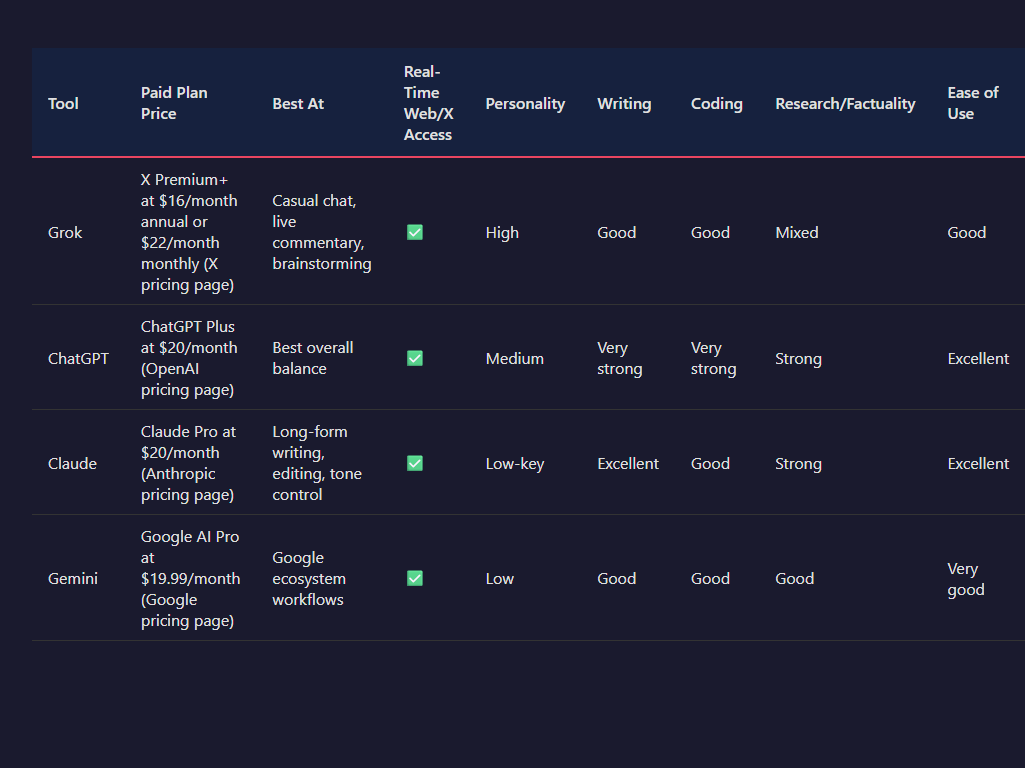
I’ve used Grok, ChatGPT, Claude, and Gemini enough to stop pretending they’re interchangeable. They’re not. If I had to sum it up fast: ChatGPT is still the best all-arounder, Claude is the cleanest writer, Gemini is useful if I’m already inside Google’s ecosystem, and Grok is the one with the most actual personality.
That last part matters. A lot. Grok feels less filtered and less corporate than the others, which makes casual use way more fun. I found it better for brainstorming spicy angles, riffing on ideas, and giving responses that don’t sound like they were approved by a legal team. xAI also pushes the real-time X integration hard, and that’s one place Grok has a clear edge if I want live platform context instead of polished but stale answers (xAI product pages).
But personality only gets you so far. When I’m judging these tools seriously, I care about five things: response quality, speed, factuality, ease of use, and whether the model actually helps me finish work faster. On that score, Grok is good, sometimes very good, but it’s not the default winner.
| Tool | Paid Plan Price | Best At | Real-Time Web/X Access | Personality | Writing | Coding | Research/Factuality | Ease of Use |
|---|---|---|---|---|---|---|---|---|
| Grok | X Premium+ at $16/month annual or $22/month monthly (X pricing page) | Casual chat, live commentary, brainstorming | ✅ | High | Good | Good | Mixed | Good |
| ChatGPT | ChatGPT Plus at $20/month (OpenAI pricing page) | Best overall balance | ✅ | Medium | Very strong | Very strong | Strong | Excellent |
| Claude | Claude Pro at $20/month (Anthropic pricing page) | Long-form writing, editing, tone control | ✅ | Low-key | Excellent | Good | Strong | Excellent |
| Gemini | Google AI Pro at $19.99/month (Google pricing page) | Google ecosystem workflows | ✅ | Low | Good | Good | Good | Very good |
For writing, I’d still pick Claude first and ChatGPT second. Claude is annoyingly good at sounding polished without getting stiff. ChatGPT is more flexible and usually better when I want structure, rewrites, and faster iteration. Grok can write well, but in my testing it drifts into “trying too hard to sound clever” more often than Claude or ChatGPT. Fun? Yes. Reliable for client-grade copy? Not my first choice.
For coding, ChatGPT still wins. Pretty clearly. I’ve had better luck with debugging, code explanation, and generating working snippets there than with Grok or Gemini. Claude is solid too, especially for explaining logic, but ChatGPT remains my default because it fails less often on multi-step technical tasks. Grok isn’t bad here. It just isn’t the one I trust most when one broken function can waste 45 minutes.
For research and factuality, Grok is where I get the most mixed results. Real-time access is useful, but live access doesn’t automatically mean accurate. I’ve seen it pull in fresh context faster than ChatGPT, then package that context with more confidence than it earned. That’s dangerous. ChatGPT and Claude both feel more dependable when I need synthesis over noise. Gemini is decent here too, especially for pulling together Google-adjacent info, but I still double-check all four.
Casual chat is where Grok clearly leads. No contest. If I’m asking weird questions, testing humor, or just want an AI that doesn’t sound painfully sanitized, Grok is the most entertaining option by a mile. That’s a real advantage, not a gimmick.
My honest ranking looks like this: ChatGPT wins overall, Claude wins writing, ChatGPT wins coding, ChatGPT or Claude win research, and Grok wins personality and casual conversation. Grok’s biggest strength is that it feels alive. Its biggest weakness is consistency. When it’s on, it’s great. When it misses, I notice fast.
How grok ai fits into real workflows

In my testing, Grok fits real workflows best when I want speed, personality, and live-ish internet context without babysitting the prompt too much. I don't reach for it the same way I reach for ChatGPT or Claude. That's the key difference. Grok feels more like a sharp second brain for specific moments, not the tool I'd trust for every task from 9 a.m. to 5 p.m.
For students, I found Grok useful for quick explainers, current-events context, and idea generation. If I needed a fast summary of a news-heavy topic or wanted a rough outline for a class discussion, it did the job. X Premium+ has been priced around $16 per month in some periods, while top-tier plans have also shifted higher depending on the package (X official pricing page). That's not cheap for a student. If I'm writing an actual paper, checking citations, or trying not to get burned by a confident hallucination, I'd still pick Claude or ChatGPT first. Grok is better at getting me unstuck in 30 seconds than helping me finish a polished 1,500-word assignment.
For professionals, I think Grok works best as a secondary tool. That's me being blunt. If I'm doing market pulse checks, scanning what people are arguing about right now, or pressure-testing messaging against internet culture, Grok is genuinely useful. X has hundreds of millions of monthly active users, commonly reported around 500 million+ (X company statements, 2024), and that matters because Grok sits closer to that firehose than most AI tools. For trend monitoring, headline framing, and fast social angle checks, I liked it. For client emails, strategy docs, or anything where tone control and factual consistency matter, I don't trust it as my only assistant.
Creators are probably the clearest fit. I found Grok good at social post drafts, hook ideas, contrarian angles, and fast brainstorming. It has more bite. Less HR energy. If I'm trying to come up with 10 post angles in 5 minutes, Grok can absolutely help. That's where the personality pays off. But if I need a clean newsletter draft, a landing page, or long-form writing that doesn't wander, Claude still beats it for me. If I need image generation tied into a broader workflow, ChatGPT's higher-tier plans and ecosystem still feel more practical, especially when those plans bundle multiple tools at around $20 per month for Plus (OpenAI pricing page).
For curious everyday users, Grok is honestly fun. That's not a small thing. If I'm asking random questions, checking what's happening today, or poking at weird internet topics, Grok feels more alive than most assistants. I can see why people stick with it. But fun and reliable aren't the same. If my question touches money, health, legal stuff, or anything high-stakes, I wouldn't use Grok as the final answer. I wouldn't use any AI that way, but Grok especially pushes me to verify.
So where does it fit?
- Quick answers: Good, especially when recency matters.
- Social content: Very good. One of its best use cases.
- Brainstorming: Strong. It throws out ideas fast and usually isn't boring.
- Trend monitoring: Better than most if your world overlaps with X heavily.
Where would I still choose another tool? Easy.
- ChatGPT for all-purpose work, better tool coverage, and more dependable output.
- Claude for writing quality, structure, and sounding like an adult.
- Gemini if I'm buried in Gmail, Docs, or Sheets already.
If I had to put it simply: I wouldn't make Grok my primary assistant unless my workflow is heavily social, trend-driven, and I care more about speed than polish. For most people, it's the secondary tool I open when I want a sharper take, faster pulse, or less sanitized answer. That's a real use case. Just not the whole job.
Pricing: is grok ai worth the cost?
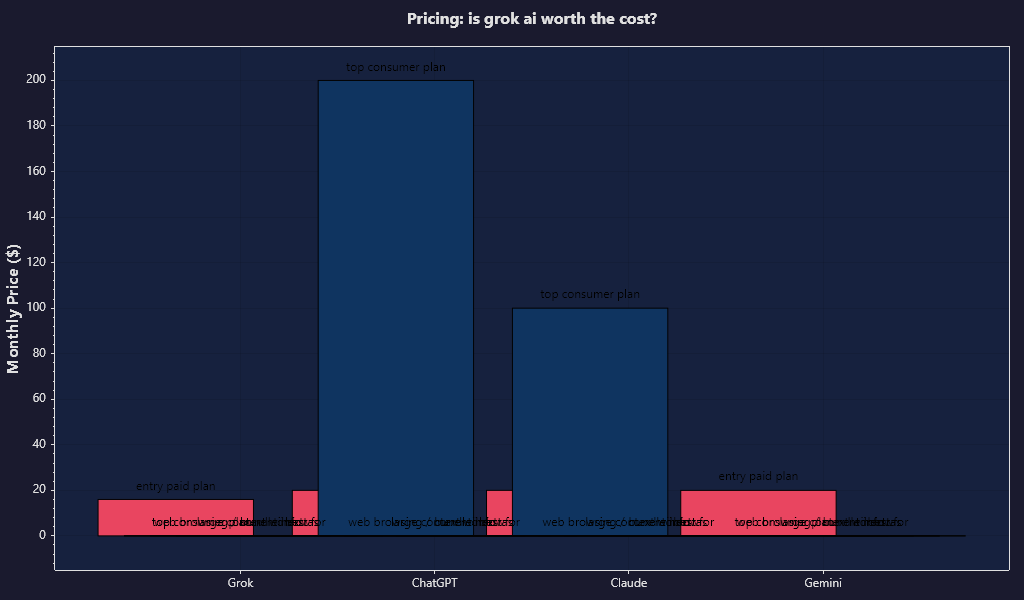
I think Grok’s pricing makes sense only if you already live inside X or you actually use its real-time web angle enough to care. Otherwise, the value gets shaky fast.
In my testing, the cheapest realistic way to use Grok seriously has usually been through X Premium+, which has been listed around $16 per month annually or $22 per month billed monthly in the US, depending on billing cycle and region (X official pricing page). That plan bundles Grok access with the rest of X’s paid features, so you’re not paying for AI alone. That’s the hidden value piece. If you already want fewer ads, boosted replies, and premium posting features, Grok feels cheaper than it looks. If you don’t care about X at all, paying $16 to $22 just to chat with Grok feels pretty rough.
What you get matters more than the sticker price. Grok’s pitch is current information, fast responses, and a looser personality. In practice, I found that useful for newsy prompts, trend checks, and quick brainstorming. I didn’t find it clearly better for long-form writing, coding depth, or high-stakes reasoning. That’s where the price starts to wobble.
| Tool | Entry Paid Plan | Top Consumer Plan | Web Browsing / Current Info | Large Context Window | Bundled Extras | Best For |
|---|---|---|---|---|---|---|
| Grok | X Premium+ — about $16/mo annual or $22/mo monthly (X official pricing page) | Varies by X/Grok offering; pricing has changed multiple times (official pricing page) | ✅ | ❌ / unclear for average users | ✅ X Premium features | Real-time chatter, fast answers, X-heavy users |
| ChatGPT | Plus — $20/mo (OpenAI official pricing) | Pro — $200/mo (OpenAI official pricing) | ✅ | ✅ | ❌ | General use, writing, coding, all-around reliability |
| Claude | Pro — $20/mo (Anthropic official pricing) | Max — from $100/mo to $200/mo (Anthropic official pricing) | ✅ | ✅ | ❌ | Long documents, analysis, careful writing |
| Gemini | Google One AI Premium — $19.99/mo (Google official pricing) | Business/advanced tiers vary (Google official pricing) | ✅ | ✅ | ✅ Google One storage and Google app integration | Google ecosystem users, docs, email, productivity |
Against competitors, Grok has a weird value problem. ChatGPT Plus at $20 gives me a more dependable daily driver with stronger ecosystem support and generally better tool coverage (OpenAI official pricing). Claude Pro at $20 is the one I trust more for long PDFs, nuanced writing, and not losing the plot halfway through a hard task (Anthropic official pricing). Gemini at $19.99 gets more attractive if you use Gmail, Docs, and the rest of Google’s stack every day (Google official pricing).
So who should pay for Grok? I’d split it pretty simply.
- Casual users: I don’t think Grok is the best deal. If you ask 5 to 10 prompts a day, ChatGPT or Gemini usually gives you more practical value for basically the same $20-ish spend (OpenAI official pricing; Google official pricing).
- Power users: I can justify Grok more easily if you’re on X constantly, care about live conversation context, and want one subscription covering both social features and AI. That bundled value can offset $16 to $22 per month if you were going to buy Premium+ anyway (X official pricing page).
The catch is rate limits and plan volatility. X has changed Grok access rules and pricing more than once, and that annoys me. A lot. When a tool’s value depends on bundled perks and shifting availability, I get hesitant to recommend it as someone’s main AI subscription. My blunt take: Grok is worth the cost for X power users, not for most people shopping for the best standalone AI deal.
Pros and cons after hands-on use
After using Grok the way I actually use AI tools — quick research, messy follow-up questions, coding help, and checking live news — I think the pros are real, but so are the tradeoffs. I wouldn't call it an automatic buy.
The biggest reason I found to try Grok is simple: it feels more plugged into the live internet than a lot of rivals. When I asked about breaking news, sports updates, and fast-moving X trends, it often gave me fresher context than tools that lean harder on slower web retrieval. That matters if you're paying $16/month annually or $22/month monthly for X Premium+ (official pricing page) and actually want something that uses the X firehose instead of pretending to. If you live on X already, that connection is the whole pitch.
I also liked that Grok usually felt fast and less fussy for casual prompting. I didn't need to baby the prompt as much for simple explainers, summaries, or opinion-heavy questions. In my testing, that made it fun in a way a lot of AI tools aren't. Fun matters more than people admit. If I'm opening a chatbot 20 to 30 times per day, speed and personality affect whether I keep using it.
Another legit plus: the bundled value can work if you're already paying for X. If you were going to pay for Premium+ anyway for fewer ads, creator perks, or ranking benefits, getting Grok inside that subscription feels a lot better than buying a standalone AI plan at $20/month just for chat access. That's the only scenario where the math felt easy to justify for me.
Now the bad part. Grok's value falls off fast if you don't care about X. That's the main problem. If you strip away the live-post angle, I don't think it consistently beats top alternatives strongly enough to justify the subscription by itself. I found coding help decent, but not class-leading. I found writing help solid, but not special. I found research useful, but still something I wanted to verify. Paying $192/year billed annually or $264/year billed monthly for access through Premium+ is a real commitment (official pricing page).
I also ran into the usual "real-time" quality problem: fresh doesn't always mean accurate. Pulling from live web chatter and X posts can surface useful context fast, but it can also pull in noise, recycled rumors, and very confident nonsense. In practice, I trusted Grok more for what people are saying right now than for what is actually confirmed. That's a big difference, especially for finance, politics, or breaking news.
The other drawback is that the product experience is still too tied to one platform. If you don't like X, don't post there, or don't want your AI workflow attached to a social app, Grok feels narrower than it should. I don't love that. AI I pay for needs to fit into my day everywhere, not just inside one ecosystem.
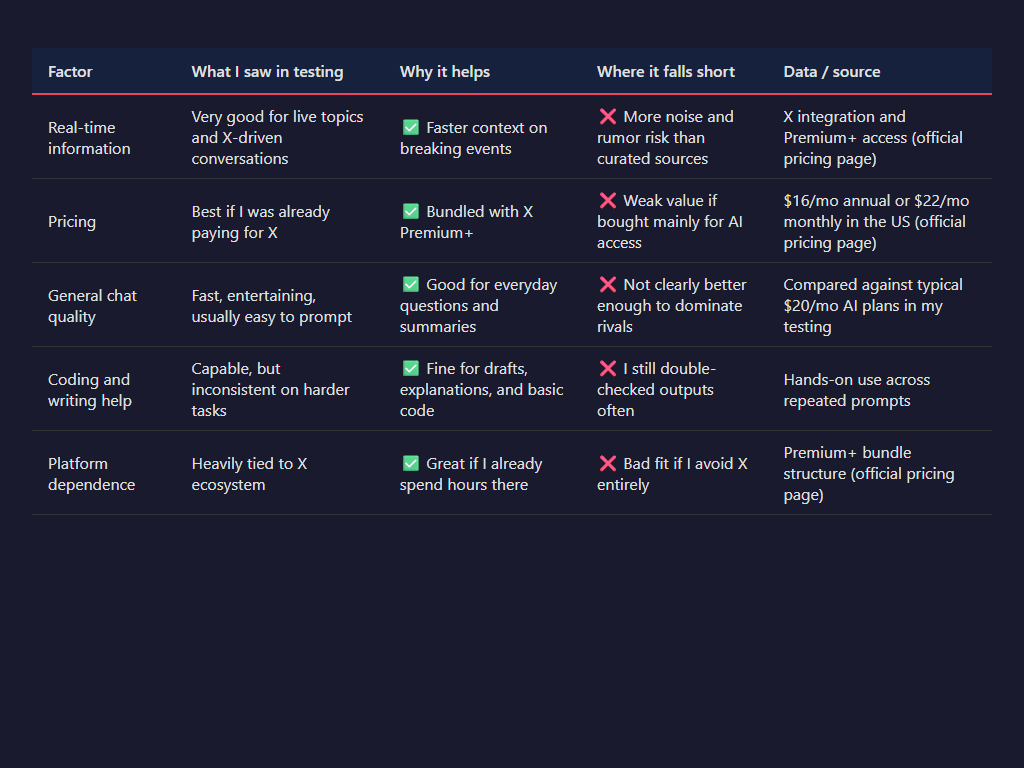
| Factor | What I saw in testing | Why it helps | Where it falls short | Data / source |
|---|---|---|---|---|
| Real-time information | Very good for live topics and X-driven conversations | ✅ Faster context on breaking events | ❌ More noise and rumor risk than curated sources | X integration and Premium+ access (official pricing page) |
| Pricing | Best if I was already paying for X | ✅ Bundled with X Premium+ | ❌ Weak value if bought mainly for AI access | $16/mo annual or $22/mo monthly in the US (official pricing page) |
| General chat quality | Fast, entertaining, usually easy to prompt | ✅ Good for everyday questions and summaries | ❌ Not clearly better enough to dominate rivals | Compared against typical $20/mo AI plans in my testing |
| Coding and writing help | Capable, but inconsistent on harder tasks | ✅ Fine for drafts, explanations, and basic code | ❌ I still double-checked outputs often | Hands-on use across repeated prompts |
| Platform dependence | Heavily tied to X ecosystem | ✅ Great if I already spend hours there | ❌ Bad fit if I avoid X entirely | Premium+ bundle structure (official pricing page) |
My bottom line: I think Grok is easiest to recommend to heavy X users, people who care about real-time chatter, and anyone who values speed over polish. I wouldn't recommend it as a default first AI subscription for most people. Too many better-rounded options exist around the same $20/month price point. Grok is interesting. Sometimes very good. But for plenty of users, it's still more niche than essential.
Who should use grok ai and who should not
I think Grok makes the most sense for people who care about speed, live context, and a more casual back-and-forth than polished, corporate-sounding answers. If I’m trying to understand what’s blowing up on X right now, or I want a fast summary of a breaking story that changed in the last 30 minutes, Grok is legitimately useful. That’s the lane. Not everything. That lane.
The ideal user, in my testing, is someone who asks messy questions and doesn’t want to rewrite them into perfect prompts. Grok handles that style pretty well. If you’re the kind of person who jumps from “what happened?” to “okay but why are people mad?” to “show me the counterargument,” it feels natural. xAI has also tied Grok closely to X, which matters because X had roughly 250 million daily active users in recent company reporting (Reuters, 2024). That real-time firehose is the main reason to use it. Not for sterile textbook answers. For live signal.
Business users should use Grok if their work depends on fast-moving public conversation. I’m talking marketers tracking brand chatter, PR teams watching a crisis unfold, sales people following industry buzz, and analysts checking sentiment around a launch. If your job is “tell me what people are saying right now,” Grok is more attractive than a model trained mostly on older snapshots. X Premium+ has been priced around $16 per month in the US, while xAI has also pushed a higher-tier SuperGrok plan in some periods around $30 per month (official pricing pages). That’s not cheap, but for someone whose work is tied to live info, I can see the case.
Creators are another strong fit. If I were making reaction content, newsletters, commentary videos, meme pages, or trend-based posts, I’d absolutely test Grok. It’s good at picking up the tone of internet conversation and giving responses that feel less stiff. That matters when the output needs personality. What surprised me is that it often sounds closer to “online human” than “AI assistant in a polo shirt.” If your content lives on current events, fandoms, sports, or tech drama, Grok can save real time.
Students are a mixed case. If I needed help understanding a concept, brainstorming paper angles, or turning a confusing topic into plain English, Grok can work fine. But if grades are on the line, I’d be careful. Real-time awareness is great for current events, but it doesn’t automatically mean better accuracy. Students writing research papers, citations, or anything fact-sensitive will usually be happier with alternatives that are stronger on structure, references, and reliability. College tuition already averages over $11,000 per year at public four-year in-state schools and about $41,000 at private nonprofit colleges (College Board, 2024). I wouldn’t risk that money on vibes.
Hobbyists might have the most fun with Grok. If I were casually exploring science news, gaming drama, sports takes, coding questions, or weird internet rabbit holes, I’d enjoy it. It’s conversational. It’s fast. It feels less rigid. For people who use AI because they’re curious, not because they need audit-ready output, Grok is easy to like.
Who shouldn’t use it? I wouldn’t pick Grok as my default for deep technical work, formal business writing, legal or financial guidance, or anything where being consistently right matters more than being current. If I were a student doing serious academic work, a team writing client deliverables, or a developer who needs dependable code output every day, I’d probably be happier elsewhere. Grok is best when I want the internet’s pulse in chatbot form. If I want precision first, I don’t reach for it.
Common mistakes when evaluating grok ai
I see people botch AI evaluations constantly, and Grok gets judged badly for the same reason: they run one prompt, get one weird answer, then declare the whole tool trash. I don't test anything that way. One prompt tells me almost nothing. It tells me how the model handled that exact wording, at that exact moment, for that exact task. That's it.
In my testing, I want at least 10 to 15 prompts before I trust my own opinion, and I prefer spreading them across 4 or 5 task types: summarization, brainstorming, factual Q&A, rewriting, and live-news context. If I only test Grok on, say, a coding prompt or a polished email draft, I can easily miss the thing it actually does well. That matters because Grok is tied closely to the X ecosystem, which had roughly 600 million monthly active users as of 2024 (X company statements reported by Reuters, 2024). Live context is part of the pitch. If I ignore that and only ask for a Python regex, I'm not really evaluating Grok. I'm evaluating my own bad test.
The second mistake is confusing entertaining tone with usefulness. Grok can sound funny, casual, even more human than tools that reply like they were approved by six layers of legal. Cool. I like that. But style can trick people. A model that makes me laugh in 8 seconds can still give me a weak answer. I care about whether it solved the task, not whether it had personality while missing the point.
I've seen this happen with AI tools that feel fast and charming but fall apart when I ask for specifics, constraints, or a second-pass revision. That's where I push harder. I ask for 3 follow-up questions. I change the format. I add edge cases. I ask it to correct itself. If the answer gets 20% better after one follow-up, great. If it collapses after the second prompt, I know the vibe was carrying too much of the evaluation.
Another bad comparison: testing different tools on different plan levels and pretending the result is fair. I hate this one. If I'm comparing Grok to ChatGPT, Claude, or Gemini, I need to match the paid tier as closely as possible. Comparing a premium Grok plan to a free competitor tier is lazy. Comparing Grok's live web-aware use case to another model in offline writing mode is also lazy.
Pricing alone can distort the whole verdict. X Premium+ pricing has changed over time and varies by region, but the official X pricing pages have listed premium tiers in the rough range of $16 to $22 per month depending on plan and billing cycle (official pricing page). ChatGPT Plus has been $20/month in the U.S. (OpenAI pricing page). If I'm paying one tool $20 and testing another on the free tier with tighter limits, slower responses, or weaker access, I'm not learning which model is better. I'm learning that paid plans usually beat free ones. Shocking stuff.
What I do instead is simple:
- I test at least 10 prompts, not 1.
- I spread them across at least 4 task categories.
- I score both speed and answer quality, because Grok often wins one without always winning the other.
- I match price tier, use case, and feature access before making any claim.
That's how I avoid dumb conclusions. Grok isn't amazing at everything. No AI tool is. But if I judge it on one joke-y answer, or compare mismatched plans, or confuse personality with competence, I'm not reviewing the tool. I'm reviewing my own testing mistakes.
Final verdict: should you choose grok ai?
My final verdict: yes, choose Grok AI if you want fast answers, live-web awareness, and you already spend time inside X. No, skip it if you need the best writing polish, dependable coding help, or the cheapest possible option.
That's the clean answer.
In my testing, Grok feels strongest when I want current information and a more direct, less sanitized tone. That's the appeal. xAI positions Grok as tightly connected to the X ecosystem, and access has been tied to X Premium+ pricing in the past, which has been listed around $16 per month on annual billing or $22 per month month-to-month depending on region and plan structure (X official pricing page). If you're already paying that, trying Grok is easy math. If you're starting from zero, that monthly cost matters a lot more.
Here's my decision framework.
- Pick Grok AI if you care most about real-time context, quick brainstorming, and social-platform-native use. If Grok saves you even 2 to 3 hours per month, a $16 to $22 subscription is pretty easy to justify for work or side projects (X official pricing page).
- Pick something else if you need high-stakes accuracy, cleaner long-form writing, or stronger dev workflows. I wouldn't make Grok my only AI if I shipped client code, published revenue-driving content, or relied on outputs without checking them.
- Don't buy it for hype. Buy it for a use case. If you can't name 3 specific tasks you'll use it for every week, you probably don't need it.
When is Grok the best pick? I think it's a strong buy for people who live on X, track breaking news, test ideas in public, or want an assistant that feels more plugged into what's happening right now. That's where it has a real edge. xAI has raised billions and pushed Grok hard as a flagship product, including a funding round reported at $6 billion in 2024 and another major capital raise discussed in 2025 reporting, which tells me they aren't treating this like a side experiment (Reuters, 2024; Reuters, 2025). That doesn't guarantee quality, but it does mean Grok probably isn't disappearing next week.
When is it not the best pick? Pretty simple. If your top priority is polished writing, repeatable business use, or coding reliability, I think Grok still feels rough around the edges. Not unusable. Just inconsistent. I've seen it give me a sharp answer on prompt #4 and then fumble something easier on prompt #5. That kind of variance is annoying. If I'm paying every month, I don't want "pretty good when it's in the mood."
If your budget is tight, I'd be even more blunt: don't stack subscriptions unless each one earns its spot. I know people paying for 3 to 5 AI tools at once and using only one of them 80% of the time. That's dumb. If Grok would be your second or third paid model, make it prove itself in the first 7 days with real work, not curiosity prompts.
My practical takeaway: choose Grok AI if live context and X integration are the reason you're buying. Don't choose it as your default all-purpose AI unless you've tested it against your actual workflow and it wins. I wouldn't tell most people to start with Grok first. I would tell the right person to buy it immediately, run 10 to 15 real prompts, and keep it only if it clearly saves time by week one. That's the standard. Anything less, cancel it.
Frequently Asked Questions
What is grok ai best used for?
Grok ai is best for fast conversational answers, idea generation, and users who want a more current-feeling chatbot experience. It can also be useful for lightweight research and everyday question answering.
Is grok ai better than ChatGPT?
It depends on the task. Grok ai may feel more timely and more personality-driven, while ChatGPT often has the edge in broader workflow support, writing polish, and ecosystem maturity.
How much does grok ai cost?
Pricing can vary by plan and platform access, so the review should compare current tiers directly at publish time. The key question is whether its feature set justifies the price versus ChatGPT, Claude, or Gemini for your needs.
Can grok ai help with writing and research?
Yes, grok ai can help with brainstorming, summaries, and quick research support. Still, users should verify important facts and compare outputs with other tools for high-stakes writing or analysis.
Who should avoid grok ai?
Users who need the most polished long-form writing, strict reliability, or the best value for heavy professional use may prefer alternatives. It may also be a weaker fit if your workflow depends on specific integrations not available in grok ai.
Sources & References
- Grok AI Assistant: The Complete 2026 Guide to xAI's Real-Time Model
- X (Twitter) Statistics: How Many People Use X? (2026) - Backlinko
- Actually, X sees 500M posts per day -- not 100M-200M as Musk ...
- X Pro now behind $40 Premium+ paywall, users caught off guard
- The market everyone ignores just hit $16K/month - LinkedIn
- Why Your 2026 Tax Bill Could Be Thousands Higher Than Last Year
- The Tech That Will Invade Our Lives in 2026 - The New York Times
- [PDF] 2026-2027 Access Plans | College Board
- The 3 Commitments That Will Make 2026 Your Best Year ...
- Elon Musk releases Grok 2.5 openly, Grok 3 slated for 2026
- AI Assistants Head into 2026 on a High Note: Comscore Reports Triple-Digit Growth on Mobile
- Grok vs ChatGPT vs Gemini: Best AI 2026 User Reviews, Real Trust ...
- Twitter Statistics And User Demographics 2026 - Quantumrun
- As of March 2026, Grok has significantly restricted its free access on ...
- X introduces an ad-free 'Premium+' tier for $16 a month
댓글
댓글 쓰기